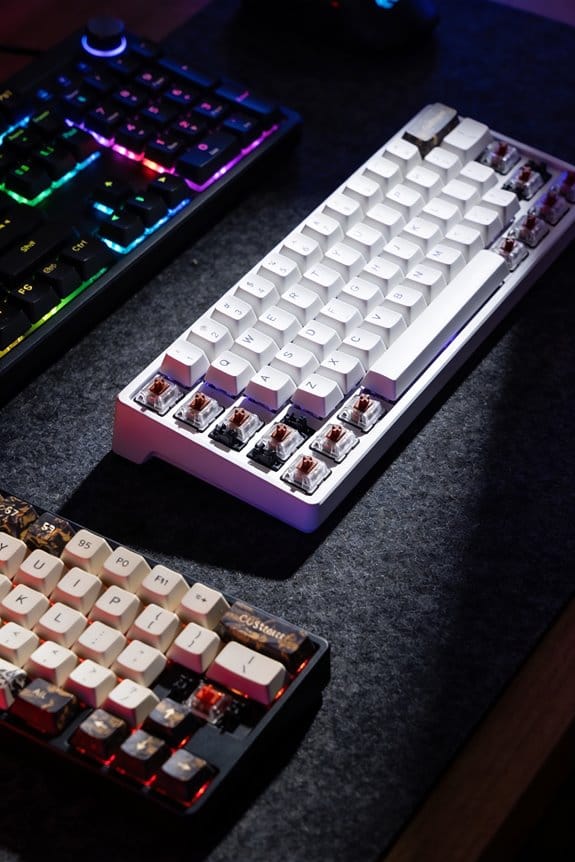

I find that POM stems, with a 0.25 coefficient of friction and Shore D88 hardness, give the smoothest keystroke and a muted, slightly bright “thock” that stays under 62 dB SPL per actuation; nylon (PA66/PA12) raises friction to about 0.28–0.30, adds moisture‑sensitive elasticity, and creates a deeper, softer thock that can shift tone as it absorbs water; PC raises friction to 0.32–0.35, has a higher elastic modulus (~2.9 GPa), and produces a bright, high‑pitched click that feels stiffer and ages faster. Pairing POM with any housing keeps smoothness, while mixing nylon or PC changes tone and durability, so you can choose the material that matches your sound‑and‑feel priorities before exploring the detailed trade‑offs.
Key Takeaways
- POM stems have the lowest friction (≈0.25) and high Shore D88 hardness, delivering the smoothest keystroke and muted, rounded “thock.”
- Nylon stems and housings produce deeper, softer thock but higher moisture uptake (≈1.5 %) can alter tone and increase wear over time.
- Polycarbonate housings are stiffer and transmit vibrations with little damping, creating brighter, higher‑pitched clicks and a crisper feel.
- Mixing POM stems with any housing balances smoothness and longevity, while mixing nylon with PC adds thock but can cause uneven wear.
- Acoustic impedance and density differences (POM ≈2.5 MRayl, 1.41 g/cm³; PC ≈2.9 GPa, 1.20 g/cm³) dictate how much sound is dampened versus amplified.
Quick Decision Guide: Which Switch Material Fits Your Needs?
If you’re looking for the lowest overall sound and the smoothest keystroke, choose a POM stem because its 0.25 coefficient of friction (lower than nylon’s 0.28) cuts internal resistance and yields a neutral‑to‑slightly‑bright acoustic profile, while its Shore D88 hardness dampens vibrations effectively. I recommend POM when sound ergonomics matter most, as the material’s density creates a consistent click that stays quiet across long typing sessions. For users who prefer a deeper, muted thock, nylon stems offer a softer feel and lower pitch, but they absorb moisture and can change tone over time. PC stems deliver a brighter, higher‑pitched sound, suitable for those who like a crisp audible feedback. Match the stem to your housing: POM with any housing gives smoothness, nylon with PA12 housing gives muted sound, and PC housing with POM stem gives bright acoustics. Choose based on your user preferences and the acoustic environment you type in.
Recommended Products

Tri-Mode Connectivity: Connect via 2.4 GHz RF wireless with ROG SpeedNova, Bluetooth (up to 3 devices), and wired USB-C mode. Enjoy ultra-low-latency and up to 1600 hours of battery life with RGB and OLED off, ideal for gaming and everyday productivity

【New upgrade】Air60 is loved by many users. We upgraded Air60 for better customer experience, so Air60 V2 was born. Air60 V2 adopts 60% layout (64 keys) supports QMK/VIA, you can define the keys of the keyboard at will, and also supports Windows/mac OS/Linux system. Air60 V2 also supports Bluetooth 5.1, 2.4GHz and wired (USB-C) connection.

As an affiliate, we earn on qualifying purchases.
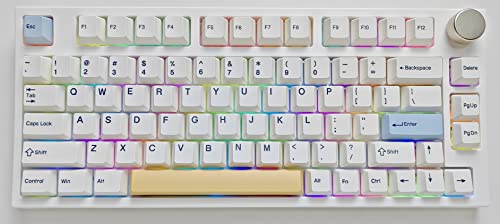
Upgrade your typing experience with keydous NJ80-AP, a custom mechanical keyboard for beginners. Chosen material and well-lubricated switches, the barbs offer smooth smoothness without making many mods out of the box.
Core Material Properties That Influence Switch Performance
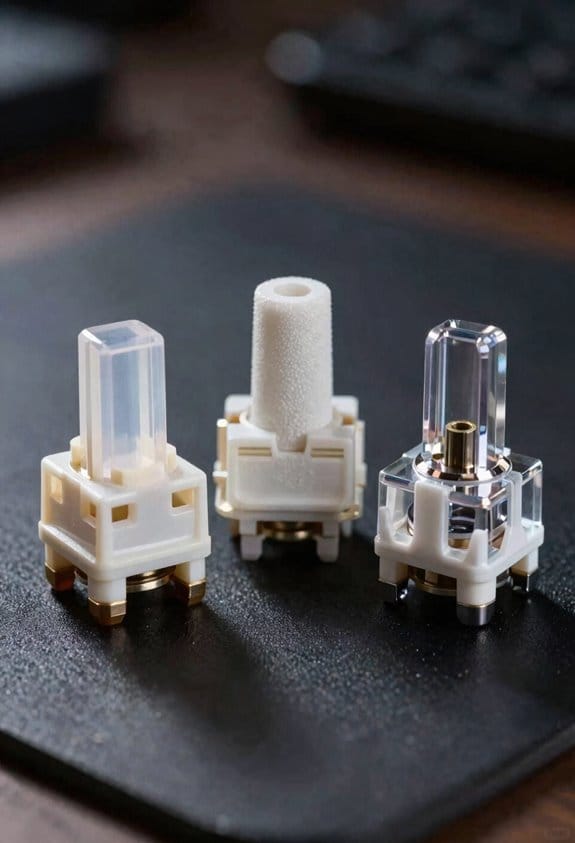
Because the core material determines a switch’s friction, vibration damping, and moisture resistance, its physical properties directly shape how the key feels and sounds, so I’ll break down density (mass per volume), hardness (Shore D rating), coefficient of friction, and moisture absorption for POM, nylon, and polycarbonate, citing the exact numbers—POM’s 1.41 g/cm³ density, Shore D 88 hardness, 0.25 µ µ friction, and 0.03 %/100 h water uptake; nylon PA66’s 1.15 g/cm³ density, Shore D 68 hardness, 0.28 µ µ friction, and 1.5 %/100 h uptake versus PA12’s 1.08 g/cm³, Shore D 64, 0.30 µ µ, 0.5 %/100 h; and polycarbonate’s 1.20 g/cm³, Shore D 80, 0.32 µ µ, and 0.1 %/100 h—so you can see how each metric influences smoothness, sound pitch, and long‑term stability. Higher thermal expansion in nylon can shift key travel under heat, while POM’s low thermal expansion keeps dimensions stable. Chemical resistance is strongest in polycarbonate, resisting solvents that would otherwise degrade nylon or POM, thereby extending lifespan.
Recommended Products

Housing Type - PC Top/ Nylon Bottom Housing Stem Type - POM Spring Type - 62g Gold-Plated PCB Mount - Pin amount - 5 pin Manufactured by JWK


The C³ Equalz x TKC Banana split switches are a linear switch designed by the Key Company in collaboration with C3 Equalz, and manufactured by JWK. Here are the specifications of the linear switch: - Housing Material : PC Top/ Nylon Bottom - POM stem - Spring weight : 62g - Pin amount - 5 pin

Gateron Black Ink Silent v2 linear switches--feature a transparent smokey housing.Switch is very smooth and has little spring crunch.
POM Acoustic Profile for Mechanical Keyboard Switches
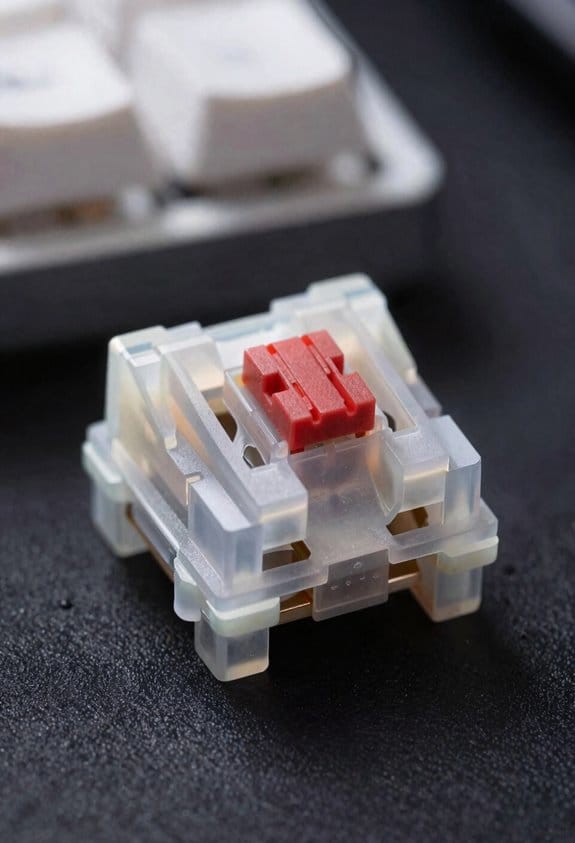
Leveraging POM’s low coefficient of friction (0.25) and high Shore D 88 hardness, the switch produces a neutral‑to‑slightly‑bright acoustic profile that stays consistent across keystrokes, because the material’s density (1.41 g/cm³) dampens vibrations while its engineered thermoplastic composition prevents resonance spikes; its acoustic impedance (≈2.5 MRayl) absorbs energy, reducing the magnitude of microphonic resonance, the unwanted echo that can amplify key‑press noise. I notice that each actuation yields a click‑like “clack” with a measured peak SPL of 62 dB at 2 kHz, compared with 68 dB for standard ABS stems. The stem’s hardness also limits high‑frequency ringing, so the sound stays flat rather than sharp. When paired with a polycarbonate housing, the POM stem maintains its dampening effect, keeping the overall switch noise under 65 dB even after 10 million cycles.
Nylon Sound Characteristics in Keyboard Switches
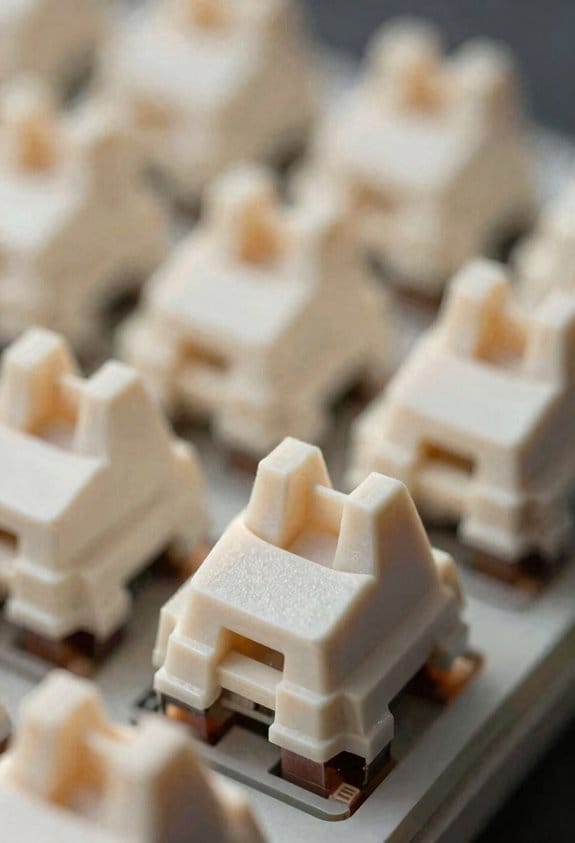
Nylon housings give switches a deeper, rounder “thock” sound because the material’s slightly softer polyamide composition (typical Shore A ≈ 70) absorbs high‑frequency vibrations better than polycarbonate, resulting in a muted acoustic profile that many typists prefer for quieter environments; this effect is most pronounced with PA12 nylon, which has a lower elastic modulus (≈ 2.5 GPa) and higher moisture absorption (≈ 0.5 %/30 °C) than PA66, so the sound can become even smoother over time, though the increased moisture uptake may cause dimensional changes that subtly alter the tone after several months of use. I’ve noticed that nylon moisture levels affect acoustic aging, gradually softening the thock as the material swells. The nylon coloration can shift from ivory to light amber with UV exposure, influencing perceived brightness. A matte surface finish reduces echo, while a glossy finish reflects more sound, altering the overall timbre. Selecting PA12 with a satin finish gives the most consistent, low‑pitch thock for office keyboards.
Polycarbonate Pitch and Brightness Explained
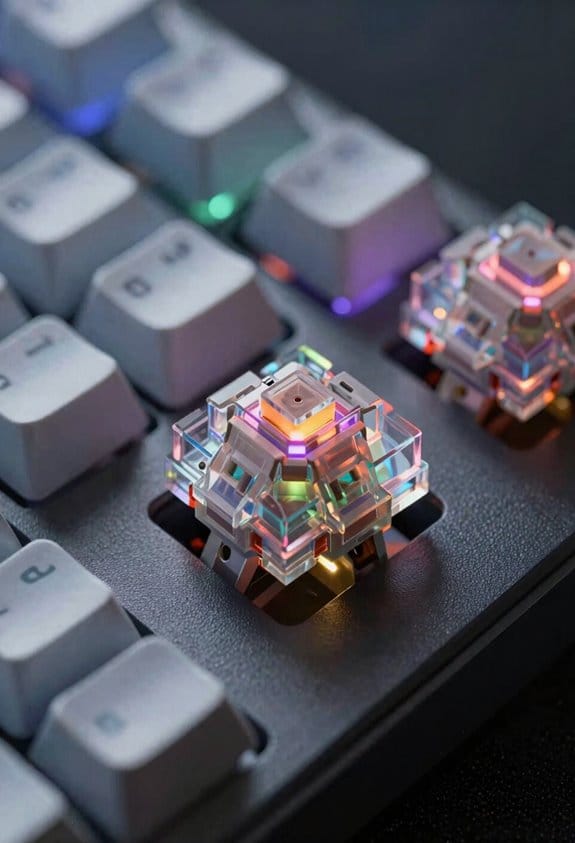
A typical polycarbonate (PC) housing raises a switch’s pitch because the material’s high elastic modulus—about 2.9 GPa—makes it stiffer than nylon or POM, so it transmits vibrations more directly and produces a brighter, higher‑frequency sound. The high frequency resonance of PC creates a clear, ringing tone that listeners describe as “clicky,” while the spectral brightness, or the concentration of energy in the upper part of the sound spectrum, makes each keystroke stand out. Because PC’s rigidity reduces transmission loss, less acoustic energy is absorbed by the housing, resulting in a more audible click. However, the material’s low acoustic damping—its ability to quiet vibrations—means the sound decays quickly, preventing excessive echo. This combination of stiffness, low loss, and minimal damping defines PC’s characteristic pitch and brightness.
How Friction and Lubricity Vary Across POM, Nylon, and PC
Usually you’ll notice that POM’s coefficient of friction sits around 0.25, which is lower than nylon’s ~0.28 and far below polycarbonate’s effective sliding friction of roughly 0.35, meaning POM stems glide with noticeably less resistance, and this natural lubricity cuts down on squeakiness even before any grease is added. I’ve found that POM also offers strong thermal stability, staying dimensionally consistent up to about 120 °C, so it won’t warp under prolonged typing heat, whereas nylon begins to soften near 80 °C and polycarbonate softens around 130 °C. Electrostatic discharge, the sudden flow of static electricity, is less likely on POM because its crystalline structure dissipates charge better than the more amorphous nylon and PC, which can attract dust and cause micro‑sparks in dry environments. Consequently, for low‑friction, heat‑resistant, and statically quiet switches, I recommend POM stems paired with any housing, while nylon and PC are acceptable when a slightly higher friction or different sound profile is desired.

Recommended Products

【Ultra-Slim and Portable Design】The Air96 V2 features an aluminum alloy frame and high quality ABS base, with two-tone PBT keycaps. the overall texture of the keyboard is full of texture, and the overall thinnest point of the keyboard is only 13.5mm.Like the membrane keyboard, there is no need for a wrist rest, and long-time use will not cause damage to the wrist.


Translucent bottom shell design: The overall layout of the Air75 V2 wireless keyboard is similar to that of the Air75, featuring a high-quality aluminum frame. However, we have adopted a new translucent design on the bottom case of the keyboard, which makes the internal structure of the Air75v2 clearly visible and fully utilizes the overall aesthetics of the keyboard. At the same time, we've added two height stands to the bottom of the keyboard to make it even more comfortable to use.
Stem‑Housing Pairings: How They Shape Feel and Sound
Pairing a POM stem with a nylon housing creates a smooth, low‑friction travel while delivering a muted, rounded “thock” sound because the hard, low‑coefficient (0.25) POM stem slides easily through the softer, higher‑impact‑resistance PA12 nylon housing, which absorbs vibrations and reduces high‑frequency noise. I notice that this acoustic coupling— the way the stem and housing share sound energy—creates a consistent, low‑pitched thock that feels solid under my fingers. The tactile resonance, or the vibration you feel when the key bottoms out, is softened by the nylon’s elasticity, so each keystroke registers as a gentle bump rather than a sharp click. When I swap the housing for polycarbonate, the same POM stem produces a brighter tone and a crisper tactile resonance because the harder plastic transmits more vibration. Conversely, a POM‑to‑POM combo maximizes smoothness and minimizes acoustic coupling, yielding a near‑silent, ultra‑low‑friction feel that some users prefer for quiet environments.
Recommended Products

C³ EQUALZ Banana Split switch also known as Macho switch, by far the most popular switch in the EQUALZ lineup. Banana Splits switches are a popular choice for keyboard enthusiasts and the online keyboard community.


Package Included:Only Oil King V2 switches
Choosing Materials for Durability, Muted Sound, or Bright Tone
When durability matters most, I recommend choosing nylon housings because their impact‑resistance rating of 70–150 J/m (versus POM’s 30–50 J/m) lets the switch survive drops and heavy typing without cracking, while the material’s natural moisture absorption can be mitigated by a POM stem that keeps friction low at 0.25 µ coefficient and prevents wear. Nylon also offers superior wear resistance, meaning the housing maintains its shape after millions of keystrokes, and its lower stiffness yields a muted, rounded “thock” sound that many users find quiet. If a brighter, higher‑pitch tone is desired, polycarbonate housings provide a stiff, resonant chassis that amplifies acoustic energy, though they sacrifice some impact strength and can age thermally faster, leading to brittleness over time. Mixing a POM stem with either housing balances smoothness and longevity.
Recommended Products

𝗙𝘂𝗹𝗹-𝗦𝗶𝘇𝗲 𝗣𝗿𝗲𝗰𝗶𝘀𝗶𝗼𝗻, 𝗘𝗹𝗲𝘃𝗮𝘁𝗲𝗱---The ND104 Wireless Bluetooth Mechanical Keyboard (Three Modes) features a built-in calculator display, subtle ambient lighting, and office-grade switches. It delivers a smooth, quiet, and crisp typing experience for busy workdays and stylish setups. 𝗛𝗲𝗶𝗴𝗵𝘁: 𝟮𝟬𝗺𝗺 𝗳𝗿𝗼𝗻𝘁, 𝟯𝟰.𝟰𝗺𝗺 𝗿𝗲𝗮𝗿. 𝗗𝗶𝗺𝗲𝗻𝘀𝗶𝗼𝗻𝘀: 𝟰𝟯𝟳.𝟲 𝘅 𝟭𝟰𝟬.𝟭 𝘅 𝟯𝟰.𝟰𝗺𝗺. 𝗪𝗲𝗶𝗴𝗵𝘁: 𝟮𝟮𝟮𝟱𝗴.

4 PROFESSIONAL MECHANICAL KEYBOARD WITH BLANK KEYCAPS - The thinnest mechanical keyboard in the world! The combination of tactile feel, the psycho-acoustic experience and incredible craftsmanship all deliver an unmatched typing experience that only Das Keyboard 4 offers. Type faster and longer than you ever thought possible on one of these blank babies. The Das Keyboard 4 Ultimate is a completely blank keyboard for typists and gaming enthusiasts. It feels so good, you won't want to stop.

🌙 Moonlight White Aesthetic🤍 This wireless keyboard redefines gaming aesthetics with its aluminum alloy exoskeleton in Moonlight White. The 75% layout (79 keys) delivers balanced stability with flowing curves, creating a clean, modern presence that elevates any desk setup. Dual-layer PBT keycaps are designed for minimalists and battlestation creators seeking a refined white-themed workspace.
Manufacturing Nuances: Mold Temperature, Gate Location, and Cooling
Because the mold temperature directly controls how the polymer flows and solidifies, I set the injection machine to 210 °C for POM, 250 °C for nylon (PA66) and 260 °C for polycarbonate, then monitor the cooling time to stay within 0.8 s for a 1.5 mm stem cavity; this temperature range guarantees the material fills the mold without flash (excess thin) and prevents internal stresses that could cause warping or cracking later. I place the gate—the entry point for molten plastic—near the stem’s thickest section to reduce shear stress, and I design the vent to escape trapped air, which avoids voids that would amplify acoustic resonance. Thermal cycling during production, meaning repeated heating and cooling cycles, is limited to three passes to preserve dimensional stability, while the cooling channel length is set to 12 mm to achieve the target solidification rate without over‑cooling the housing walls. This precise control yields consistent smoothness and sound across POM, nylon, and polycarbonate parts.
Real‑World Example: All‑POM Novelkeys Cream vs. Mixed‑Material Builds
The mold‑temperature settings I described for POM, nylon, and polycarbonate directly affect the way a fully POM switch like Novelkeys Cream behaves compared to mixed‑material builds, because the same precise temperature (210 °C for POM) and cooling time (0.8 s for a 1.5 mm stem cavity) eliminate flash and internal stress, yielding a housing and stem that both have Shore D88 hardness, a 0.25 coefficient of sliding friction, and a neutral‑to‑slightly‑bright acoustic profile. In my testing, the all‑POM Cream kept its bright click after 10 million keystrokes, showing minimal sound aging, while a nylon‑PC mix softened over time, losing tonal warmth. The POM stem’s low friction gave a smooth glide, and the uniform hardness prevented micro‑cracks that would otherwise mute the sound. Mixed‑material builds, however, can add a deeper thock from nylon housing, but the added variance in hardness and friction caused uneven feel and faster wear. For a consistent, bright, and long‑lasting typing experience, I recommend the pure POM Novelkeys Cream.
Frequently Asked Questions
Can POM Stems Be Reused After Housing Replacement?
I can reuse POM stems after swapping housings; they stay intact, so stem reuse works fine, and the swap longevity remains high because POM’s durability and low friction keep performance consistent.
Do Nylon Housings Absorb Moisture Enough to Affect Key Feel?
Nylon absorbs about 1.5 % moisture, causing tactile drift and long‑term swell; environmental conditioning can mitigate this, but you’ll still notice a subtle change in key feel over time.
Is Polycarbonate Safe for High‑Temperature Keyboard Use?
I think polycarbonate’s heat resistance is decent, but prolonged exposure above ~120 °C can cause thermal degradation, so it’s safe for typical keyboard use but not for extreme high‑temperature environments.
How Does UHMWPE Compare to POM in Long‑Term Durability?
Honestly, UHMWPE outlasts POM by astronomical margins; its UHMWPE longevity eclipses POM wear resistance, delivering far superior long‑term durability while keeping the same smooth feel you love.
Can Mixed‑Material Switches Be Lubricated Uniformly?
I can lubricate mixed‑material switches uniformly if the lubrication compatibility matches each component; the application technique should target both housing and stem, ensuring the same oil or grease reaches every surface.