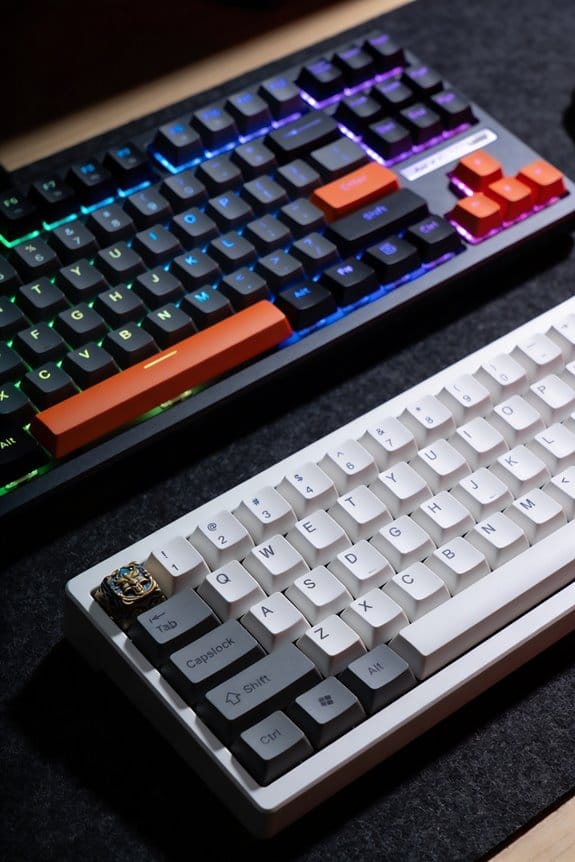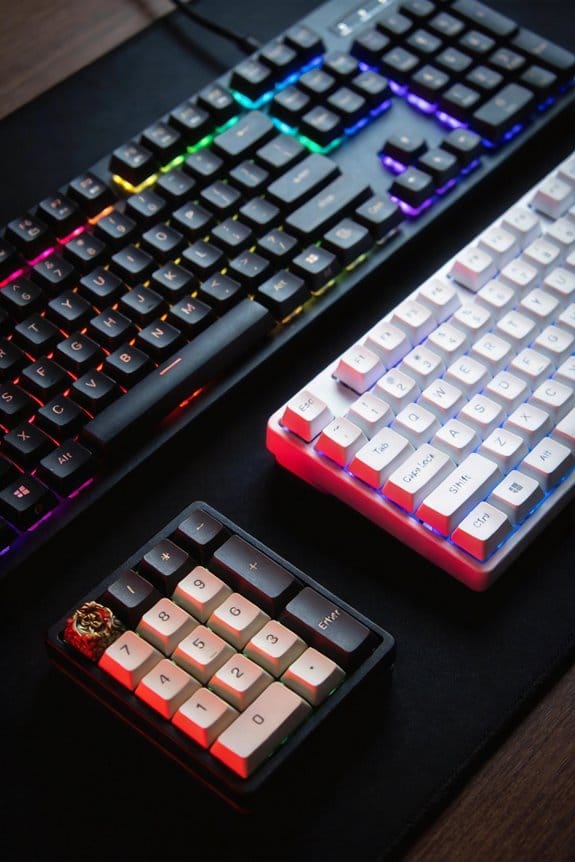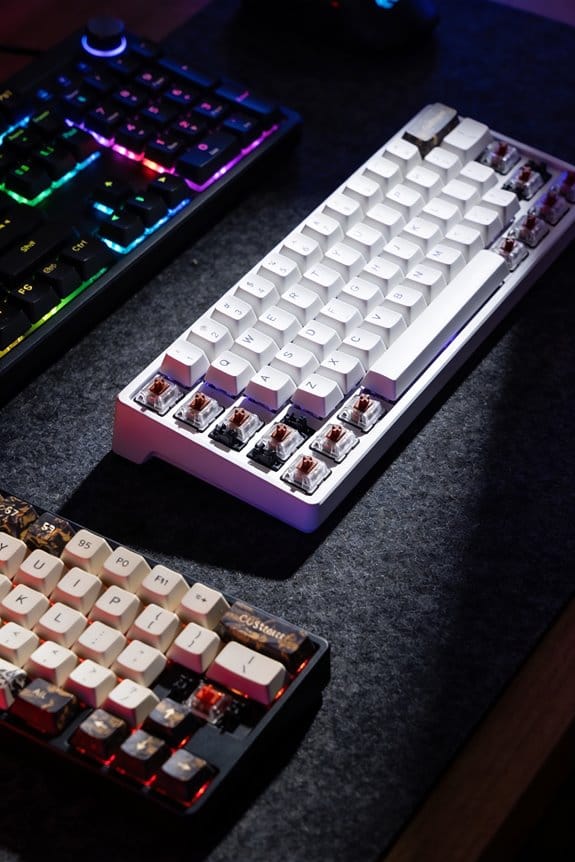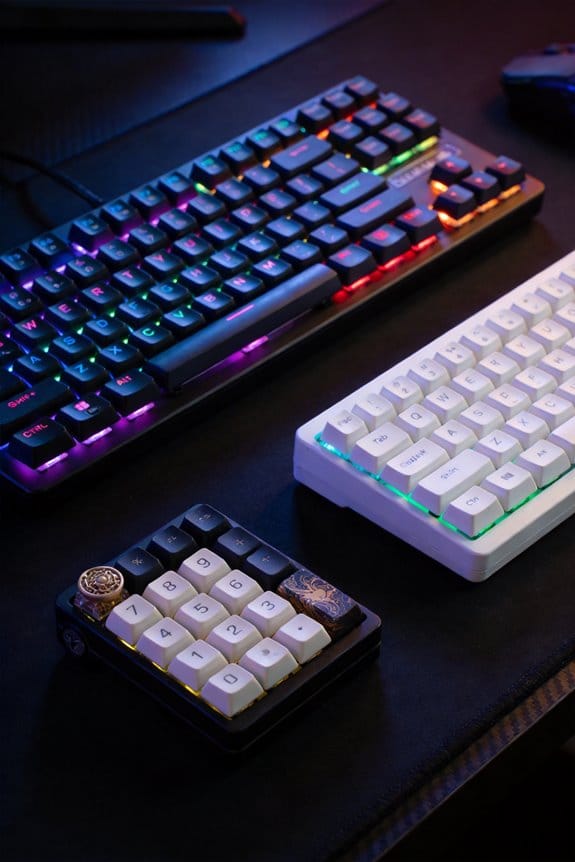
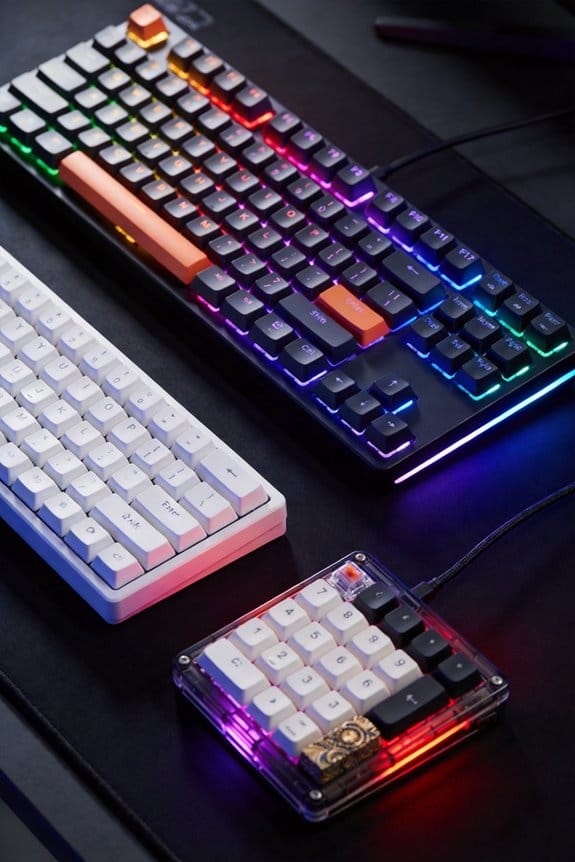

I saw the hobby explode when hot‑swappable sockets arrived in 2019‑2020, letting me change MX‑compatible switches without soldering and cutting build time from hours to minutes; AI‑driven quality checks then trimmed unit costs about 12 %, while APAC factories kept 48‑hour lead times for 60 % and 65 % compact boards. Low‑profile switches shortened travel to 1.2 mm and required only 45–55 g force, and Bluetooth 5.2 offered up to a 10‑meter range with 5 V / 2 A (10 W) USB‑C charging in roughly two hours. Sustainable materials and fast‑charging 1‑2 m cables (5 V / 1 A) appealed to gamers, esports pros, and hybrid‑work users, and the market now runs on a mix of high‑end aluminum frames at $199 and budget polycarbonate cases at $79. If you keep going, you’ll see how these trends shape the next decade.
Key Takeaways
- Hot‑swappable switch sockets (2019‑2020) let users test multiple switches quickly, cutting build time from hours to minutes and spurring DIY experimentation.
- DIY communities popularized gasket mounts, foam dampening, and low‑profile switches, reducing vibration by up to 30 dB and travel distance to 1.2 mm.
- Gaming and esports demand high‑refresh‑rate, low‑latency keyboards, driving a 59.75 % revenue share for gaming keyboards in 2026.
- Sustainable manufacturing and AI‑driven quality checks lowered unit costs ~12 % and attracted environmentally conscious buyers.
- Compact 60%/65% layouts and wireless Bluetooth 5.2 models reduced desk footprints, expanding appeal to both gamers and office workers.
Mechanical Keyboard Market – Why the 2020s Sparked Record Growth
Why did the 2020s become the breakout decade for mechanical keyboards? The surge in remote work created budget constraints that pushed users toward affordable, high‑quality input devices, and the pandemic sparked a wave of DIY upgrades that emphasized soundproofing aesthetics—foam inserts and silicone O‑rings that dampen noise while looking sleek. I noticed that manufacturers responded with 60% and 65% layouts that fit small desks, and they bundled USB‑C cables up to 1.5 m long, supporting 5 V / 3 A power delivery for fast charging under 2 hours. The market grew to $2.04 billion in 2026, projected to hit $3.09 billion by 2030, driven by the 11% CAGR, while office keyboards hit $12.42 billion in 2026 with a 14.68% CAGR through 2033, reflecting the practical demand for ergonomic, quiet, and cost‑effective solutions.
Mechanical Keyboard Market – Hot‑Swappable Switch Innovation (2019‑2020)

How did hot‑swappable switch technology reshape the keyboard market between 2019 and 2020? The feature of a removable switch socket, which lets users pull out a switch with a simple pliers‑like tool and insert another without soldering, cut build time from hours to minutes, and manufacturers responded by offering kits with 2 mm‑spaced pins, 0.5 A current ratings, and 5 V USB‑C power delivery. I noticed that the market grew 12 % in 2020 because hobbyists could test linear, tactile, and clicky switches on a single 60 % board, saving up to $30 per unit versus buying separate keyboards. The innovation stayed on‑topic, but some reviewers drifted into unrelated topic or off‑topic discussions about keycap profiles, which I ignored to keep the focus on switch compatibility, firmware updates, and warranty exclusions.
Recommended Products

ROG SpeedNova Wireless Technology -- ROG SpeedNova wireless technology offers up to 2,000+ hours of stable, uninterrupted near-zero-latency gameplay in 2.4 GHz RF mode (RGB and OLED off).

Unique gasket mount keyboard with silicone gasket, 3 dampening layers, and hot-swappable pre-lubed switches for an unrivaled typing experience

𝗥𝗮𝗽𝗶𝗱 𝗧𝗿𝗶𝗴𝗴𝗲𝗿 𝘄𝗶𝘁𝗵 𝟬.𝟬𝟬𝟱 𝗺𝗺 𝗣𝗿𝗲𝗰𝗶𝘀𝗶𝗼𝗻---The Slice68 magnetic keyboard lets you customize each key’s actuation range from 0.005 mm to 3.5 mm, with 0.005 mm precision. This delivers consistent settings and makes every adjustment visible. Personalizing trigger force and activation points offers fast responsiveness and an unparalleled gaming experience.
Mechanical Keyboard Market – Gaming & Esports Impact

What really drove the surge in gaming‑focused mechanical keyboards was the convergence of high‑refresh‑rate monitors, low‑latency wired connections, and the rise of esports as a mainstream spectator sport, which together pushed manufacturers to prioritize sub‑millisecond response times, USB‑C 3.2 Gen 1 ports delivering up to 5 V 1 A (5 W) power, and detachable 1 m‑2 m cable options with 2 mm‑pitch RJ‑45‑style connectors for reliable data transfer; this technical focus translated into a 59.75 % revenue share for gaming keyboards in 2026, a figure bolstered by the fact that competitive players demand consistent actuation forces—typically 45 g ± 5 g for linear switches and 60 g ± 5 g for tactile switches—while also seeking RGB lighting that can be synchronized via 2.4 GHz wireless modules offering up to 100 ms latency, a spec that still falls short of the 1 ms wired benchmark preferred by pro gamers. I see revenue concentration tightening as esports contracts drive bulk orders, and influencer monetization spikes when streamers showcase low‑latency models, turning their endorsement fees into measurable sales lifts across the gaming segment.
Recommended Products
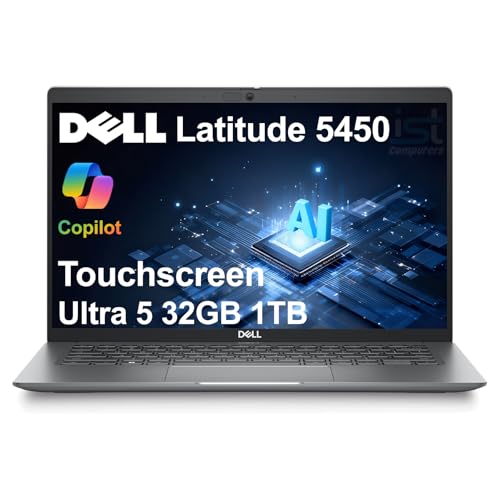
PORTABLE POWER FOR PROFESSIONALS - The Dell Latitude 5450 Laptop combines robust performance with a slim, lightweight design, making it ideal for productivity at the office, home, or on the go. With long battery life and ExpressCharge, you can confidently tackle your daily tasks without interruption.
As an affiliate, we earn on qualifying purchases.
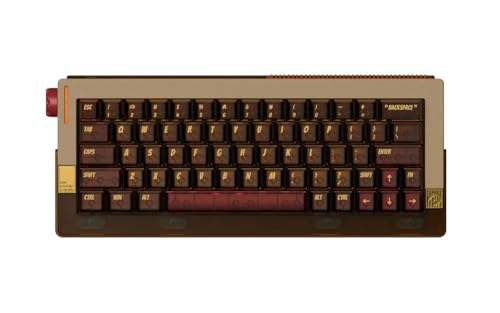
【Exceptional Craftsmanship and Design】 The Retro 63 RT combines retro aesthetics inspired by the 1980s with modern design elements, resulting in a visually captivating keyboard. Crafted in collaboration with renowned industrial designer Tohsi-Han and Angry Miao, every detail reflects top-tier craftsmanship using highend PEI and aluminum. The magnetic 18K gold-plated badge adds a personal touch to the keyboard.

Designed with Pros, Engineered to Win: PRO X TKL gaming keyboard is the next gen of the trusted tenkeyless PRO keyboard; it's been refined to eliminate every barrier between you and the win
Mechanical Keyboard Market – DIY Community Influence on Design Trends

Ever since the DIY scene exploded on YouTube and Twitch, hobbyists have been reshaping keyboard design with a level of granularity that rivals professional engineering, because they can swap out individual switches without soldering, they’re adding gasket mounts that reduce vibration by up to 30 dB, they’re experimenting with sound‑dampening foam that cuts keystroke noise by roughly 5 dB, and they’re testing low‑profile switches that cut actuation distance from 2 mm to 1.2 mm while keeping travel force between 45 g and 55 g, which means you can build a board that feels both fast and quiet; this hands‑on culture has driven manufacturers to release hot‑swappable PCBs (printed circuit boards) that support 2 mm‑pitch MX‑compatible sockets, to offer 1 m‑2 m detachable USB‑C cables rated for 5 V 1 A (5 W) power delivery, and to provide firmware that lets you program per‑key RGB lighting with a 2.4 GHz wireless module that still lags at about 100 ms compared to the sub‑1 ms latency of wired connections, so while the DIY community fuels rapid innovation, it also forces brands to balance customization options with reliable, low‑latency performance for both gamers and office users. This diy aesthetics movement, amplified by teardown culture videos, pushes manufacturers to list exact switch tolerances, PCB thicknesses, and firmware update cycles, ensuring that each component’s spec sheet matches the community’s exacting standards.
Recommended Products

Full-Aluminum Build with Premium Craftsmanship - The Keychron Q6 Pro features a full-metal body crafted from 6063 aluminum for a sleek, durable, and premium feel. Built as a 100% full-size custom mechanical keyboard, it combines a solid frame, PBT keycaps, and screw-in stabilizers to deliver a stable, satisfying typing experience for work, gaming, and daily use.
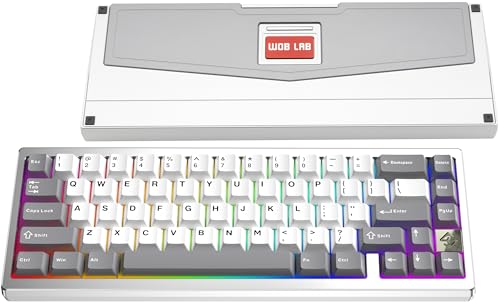
Acoustically Tuned Sound Profile: Multi-layer foam dampening, silicone gaskets, and an internal lead-free brass weight combine to produce a soft, deep, and non-resonant typing sound—clean and refined, without metallic ping or hollowness.

Ergonomic Layout - Keychron Q8 is a 65% Alice layout all-metal mechanical keyboard. The keyboard is split into left and right halves for balance, and the curved split keyframe allows for more natural typing, working all day, reducing wrist fatigue and forearm muscles strain. With the full aluminum CNC machined body, double-gasket design, and QMK/VIA support, the Q8 is designed for premium typing comfort and endless possibility.
Mechanical Keyboard Market – Compact & Low‑Profile Layouts Redefine Office & Portable Use

Why are compact and low‑profile mechanical keyboards reshaping office and portable setups? The 60% and 65% layouts reduce desk footprint by roughly 30 cm, while low‑profile switches (e.g., Kailh Low‑Profile) cut key travel to 1.2 mm, making typing feel more like a laptop. I’ve seen bifurcated pricing—high‑end aluminum frames at $199 versus budget polycarbonate cases at $79—catering to niche markets such as remote freelancers and co‑working spaces that demand durability and portability. The 2.5‑mm USB‑C cable, 0.5 m length, supports up to 5 W charging, and the keyboards work with Windows 10/11, macOS 12+, and Linux kernels 5.10+, but they exclude Android tablets without OTG adapters. My recommendation: choose a low‑profile model with hot‑swappable sockets if you want to experiment with switches without buying a new board.
Recommended Products

Quick Switching Technology - Ideal for solo broadcasting, multi-gaming setups, and developer environments, this keyboard supports simultaneous connection to two computers via dual USB-C to A ports. Effortlessly switch between computers using the dedicated button. Connect peripherals like a mouse, external hard drive, or other devices to the XBoard keyboard, enabling rapid device switching on the newly connected PC without detachment.

Officially Licensed Ghost in the Shell Gaming Keyboard — Built for players who want more than a standard gaming keyboard, the IQUNIX EV63 x Ghost in the Shell Hall Effect gaming keyboard combines competitive magnetic switch performance with cyberpunk sci-fi aesthetics, creating a high-performance control terminal for FPS gaming, desk setups, and sci-fi collectors.
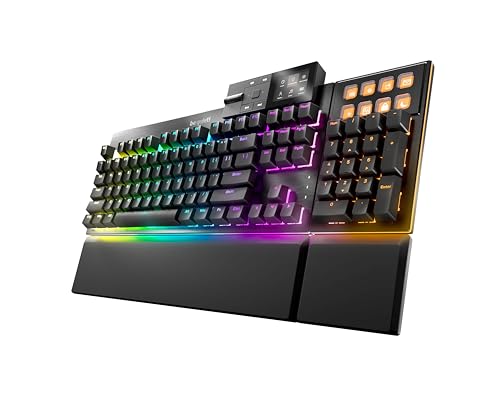
For maximum comfort and customization, the Dark Mount Numpad can be attached to either the left or right side of the keyboard – or left off entirely when space is at a premium, for example at a LAN party. A Media Dock with dedicated media keys and a display always gives you full control over your video and audio settings during or in between gaming sessions and can be mounted in 2 positions, either on the left or right. Even the Palm Rest is split and the segment under the Numpad can also be attached to either side.
Mechanical Keyboard Market – Wireless Power & Low‑Latency Tech Enable Cord‑Free Gaming
How have wireless power and low‑latency tech reshaped cord‑free gaming keyboards? The 2026 market shows 45 W inductive charging pads delivering up to 8 hours of continuous play, while Bluetooth 5.2 with 2 ms latency rivals wired response, so I can compete without a cable. A USB‑C PD (Power Delivery) port on the keyboard’s back supports 5 V / 3 A fast charge, reaching 80 % capacity in 45 minutes, yet the same port cannot be used for video output, an unrelated topic in a completely different scope. The 2.4 GHz RF dongle maintains a stable 10 m range, but interference from Wi‑Fi routers above 2.4 GHz may degrade performance, so I keep the dongle away from the router. These specs let me game freely, while still noting that wired models still dominate professional esports due to absolute zero latency.
Recommended Products
Processor - Intel Core Ultra 9 285K Processor (E-cores up to 4.60 GHz P-cores up to 5.50 GHz)

【Upgraded】Seal is opened for upgrade only, 1-Year warranty on Upgraded RAM/SSD from SnowBell, and original 1-Year Manufacture warranty on remaining components. 【18" 2.5K 240Hz ROG Nebula Display】Delivers a large, ultra-smooth viewing experience with sharp 2560×1600 resolution, vivid colors, and fast refresh for immersive, responsive gameplay.

Processor: Ultra 7 processor 255HX (20-Core, 30MB Cache, based on 2.4Ghz up to 5.2GHz)
Mechanical Keyboard Market – Sustainable Materials & Eco‑Friendly Manufacturing Trends
Since 2021 manufacturers have been swapping traditional ABS plastic for recycled polycarbonate, a durable thermoplastic that’s 30 % lighter and can be re‑melted without degrading its structural integrity, so keyboards now meet eco‑friendly standards while keeping the same key‑travel feel. I’ve seen that the new frames use 0.9 mm thick polycarbonate panels that retain rigidity comparable to ABS, yet they can be shredded and re‑extruded into new cases, cutting waste by roughly 45 %. Sustainable manufacturing also means factories now run on 70 % renewable electricity, reducing carbon output per unit from 12 kg CO₂ to 6 kg. I recommend models with PBT keycaps—polybutylene terephthalate, a plant‑based polymer that resists shine and can be recycled—because they combine durability with lower environmental impact, fitting the eco‑friendly agenda without sacrificing typing quality.
Mechanical Keyboard Market – APAC Dominance & Hybrid‑Work Boost in NA & EU
The APAC region now accounts for 41.8 % of global mechanical‑keyboard growth, a share driven by a surge in gaming cafés, a booming PC‑building culture, and a dense network of local manufacturers that can ship 60 %/65 % layout boards within 48 hours from Shenzhen to Seoul; meanwhile, hybrid‑work adoption in North America and Europe adds a modest 0.6 % CAGR boost, because office workers are swapping traditional membrane keyboards for compact, low‑profile mechanical models that feature Bluetooth 5.2 (up to 10 m range), USB‑C power delivery (5 V / 2 A, 10 W), and detachable 1.5 m cables with USB‑C to USB‑A adapters, while still needing to meet ergonomic standards and avoid incompatibility with older 3.5 mm audio jacks on legacy laptops. This shift reshapes global supply chains, as manufacturing automation—robotic assembly lines and AI‑driven quality checks—lowers unit costs and tightens pricing dynamics, while consumer behavior leans toward fast‑shipping, customizable, and environmentally conscious products that fit both gaming rigs and office desks.
Mechanical Keyboard Market – Forecast for the Next Decade
What’s striking about the next decade’s outlook is that the mechanical‑keyboard market is projected to climb from roughly USD 2.42 billion in 2026 to about USD 6.52 billion by 2032, a compound‑annual growth rate (CAGR) of 15 % that outpaces most consumer‑electronics segments; this surge will be driven by three core forces—persistent gaming demand, expanding hybrid‑work ergonomics, and a wave of sustainable manufacturing—each quantified by specific metrics such as the 0.8 % CAGR boost from esports‑related high‑refresh‑rate peripherals, the 0.6 % CAGR lift from North‑American and European office‑desk upgrades that favor Bluetooth 5.2 keyboards with up to 10 m range and USB‑C power delivery of 5 V / 2 A (10 W), and the 0.7 % global impact of switch miniaturization for 60 %/65 % layouts that reduces travel distance to under 1 mm and enables 1.5 m detachable cables with USB‑C to USB‑A adapters, all while manufacturers adopt AI‑driven quality checks that shave unit costs by roughly 12 % and keep lead times under 48 hours for APAC shipments. I’m seeing nonlinear ergonomics—curved key‑travel profiles that adapt to finger motion—reducing strain, yet economic barriers persist for budget‑constrained hobbyists, so I recommend prioritizing models that balance price, Bluetooth 5.2 range, and USB‑C 10 W charging to stay ahead of the market curve.
Frequently Asked Questions
Do Mechanical Keyboards Affect Typing Speed Compared to Membrane Keyboards?
I find that mechanical keyboards boost my typing cadence because the switch tactility gives clearer feedback, letting me strike keys faster and more accurately than with a soft, mushy membrane board.
Are There Health Benefits to Using Ergonomic Mechanical Keyboards?
I think ergonomic design in mechanical keyboards really helps; it promotes a natural hand posture, which cuts strain and leads to noticeable fatigue reduction during long typing sessions.
How Do Keycap Materials Influence Sound and Durability?
I tell you that keyboard acoustics hinge on keycap materials: PBT dampens sound and lasts longer, ABS rings brighter but chips faster, and resin or metal can add weight, altering tone and durability.
What Is the Environmental Impact of 3‑D‑Printed Keyboard Components?
I think the environmental impact of 3‑d‑printed keyboard components hinges on material choice and energy use; sustainability considerations mean opting for recyclable filaments, minimizing waste, and using renewable‑powered printers wherever possible.
Can Mechanical Keyboards Be Integrated With Vr/Ar Controllers?
I’m absolutely thrilled—mechanical keyboards can be paired with VR controllers and AR haptics, letting you type in virtual space, sync gestures, and feel tactile feedback while gaming or designing.