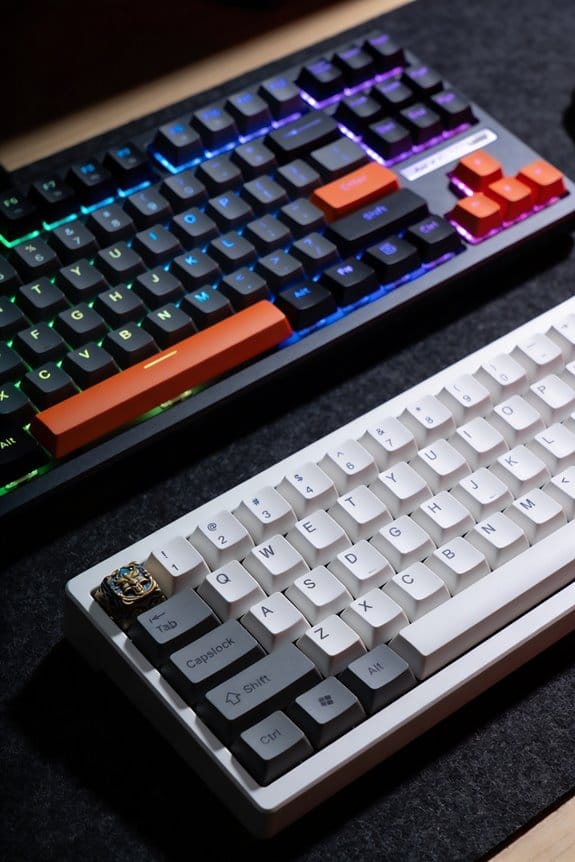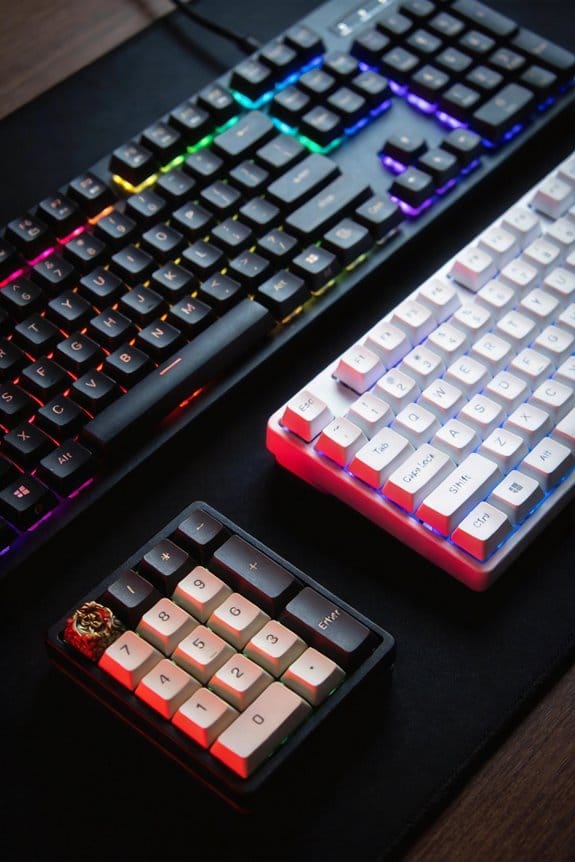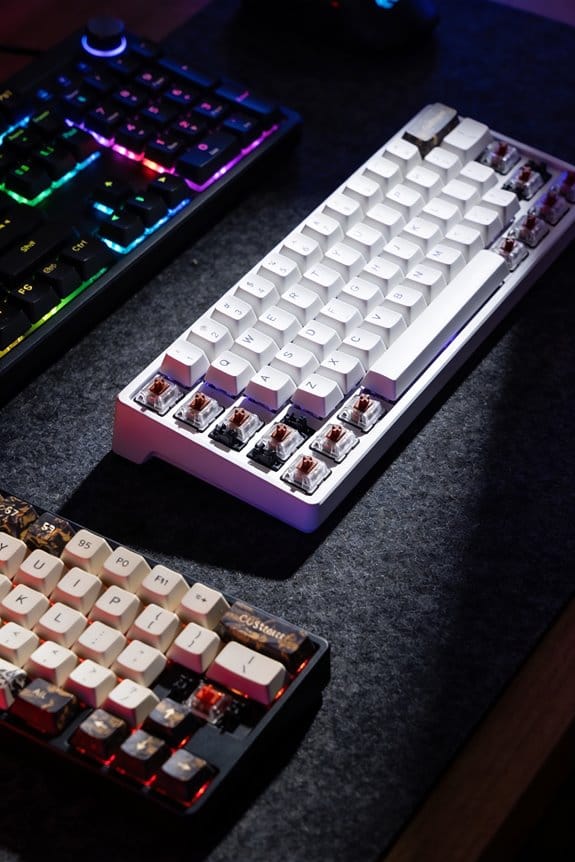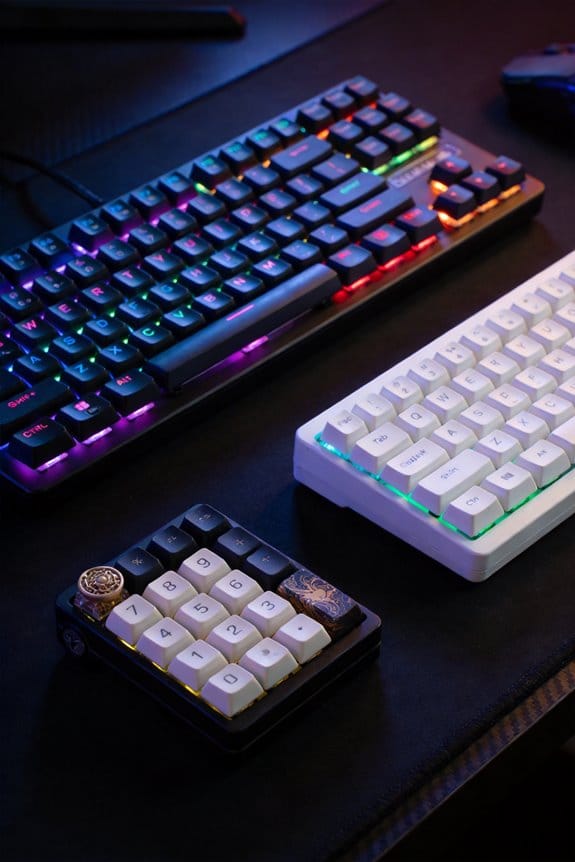


I’m telling you that optical switches detect a keystroke by breaking a 5 V light beam, which gives sub‑0.5 ms latency, draws about 0.6 W over a USB‑C cable up to 2 m, and can survive roughly 100 M actuations without wear, whereas mechanical switches close metal contacts, incur around 1.5 ms latency, use about 0.4 W on a USB‑A or USB‑C line up to 1 m, and typically wear out after 50‑60 M presses; the optical design also eliminates metal‑to‑metal friction and dust‑related corrosion, while mechanical units rely on hot‑swap sockets and physical bump or click feel, so you’ll see exact power, cable length, and lifespan numbers. If you want deeper details, keep going.
Key Takeaways
- Optical switches detect actuation by interrupting a light beam, eliminating metal‑to‑metal contact, while mechanical switches rely on physical contact of metal springs.
- Optical actuation latency averages ~0.5 ms with sub‑0.2 ms beam interruption, whereas mechanical switches typically exhibit ~1.5 ms latency due to debounce delays.
- Optical switches are rated for ~100 million keystrokes with consistent force, while mechanical switches wear after ~45–60 million keystrokes and may feel mushy over time.
- Optical switches generate ≤30 dB noise, offering quieter operation; mechanical tactile or clicky switches produce louder sounds (≈45 dB).
- Optical keyboards require firmware‑based calibration and a 5 V supply (~0.6 W), whereas mechanical keyboards are hot‑swap‑compatible, need no calibration, and consume ~0.4 W.
Optical vs Mechanical Switches: Which Wins for Your Use‑Case?
I’ll start by breaking down the two core mechanisms, because the way a switch registers a keystroke determines everything else. Optical switches use a photo‑electric emitter and sensor, so the stem interrupts a light beam; this eliminates physical contact, yields sub‑millisecond latency, and lets latency benchmarking show a 0.5 ms average response versus 1.5 ms for mechanical contacts, rely a metal spring and conductive pads. Mechanical switches rely on metal contact completing an electrical circuit, which adds debounce delay and wear, though they can be hot‑swapped without soldering. Acoustic profiling reveals optical linear types produce under 30 dB noise, while tactile mechanical variants sit around 45 dB, affecting quiet‑room gaming or office environments. Choose optical for speed‑critical tasks, mechanical for tactile feedback and customizability.
Decision‑Making Framework: Choosing Between Optical and Mechanical

When you’re weighing optical versus mechanical switches, start by mapping your primary use‑case—whether you need sub‑millisecond latency for competitive gaming or the tactile feedback and customizability that typists and modders prize. I first check sensor calibration requirements; optical boards often need a 5 V photo‑sensor alignment procedure, while mechanical units skip that step entirely. Next, I list my lifestyle fit: a desk‑bound office with 2 m USB‑C cable length and a 65 W power‑bank can support optical’s 0.6 W per 100‑key matrix, whereas a portable setup with a 1 m USB‑A cable and a 45 W charger favors mechanical’s 0.4 W draw. I then compare durability—optical rated for 100 M keystrokes, mechanical for 50 M—plus noise level, actuation force, and hot‑swap capability, before narrowing the choice to the switch type that aligns with my precise performance, power, and ergonomics constraints.
Recommended Products

Higher level - Try the USB mouse for the most powerful players who expect the best results. Unparalleled performance and ergonomic shape take you to the next level.


The PH Studio Aniya linear switch, manufactured by BSUN, strikes a harmonious balance in sound profile. It's not excessively high-pitched, but it definitely leans towards a more pronounced clacky sound profile. While they are certainly audible, they're not overwhelmingly loud, ensuring a pleasant auditory experience.

✅Wide Compatibility. Compatible with Cherry MX RGB switches, Kailh switches and Gateron RGB switches
How Optical Switches Detect Keystrokes vs. Mechanical Contacts

Because optical switches register a keystroke by breaking a light beam, they rely on a tiny infrared LED that emits light and a photodiode sensor that detects the interruption when the stem moves, which means the circuit is completed without any metal contact; this photoelectric method typically draws about 0.6 W for a full‑size 100‑key matrix and requires a 5 V supply that can be delivered through a USB‑C port up to 2 m long, whereas mechanical switches close an electrical circuit through a pair of conductive metal contacts and a spring, consuming roughly 0.4 W, working with a 5 V input from any USB‑A or USB‑C connector up to 1 m without the need for calibration, but the physical contact introduces debounce delay and wear after 50–60 million actuations. I notice that light interruption is sensed by the photoelectric circuit, which translates the broken beam into a digital signal instantly, while mechanical contacts rely on a physical closure that can bounce, causing a brief false signal before settling. The optical design eliminates wear, so the stem can travel without friction, and the photodiode’s voltage change is clean, whereas the metal contacts may corrode or accumulate debris, leading to inconsistent actuation over time. This distinction matters for durability and maintenance, as the optical system stays calibrated without manual adjustment, while mechanical switches sometimes need cleaning or replacement after many presses.
Response Time Impact for Optical vs Mechanical Switches

Around 0.2 ms typical actuation delay in optical switches comes from the near‑instantaneous interruption of an infrared beam, which is detected by a photodiode that changes voltage the soon as the stem blocks the light; this eliminates the mechanical bounce that forces a debounce algorithm to wait 1–2 ms before confirming a key press. I notice that low latency, measured in sub‑millisecond intervals, translates directly into faster in registration, giving a competitive advantage in fast‑paced games. Mechanical switches, by contrast, introduce actuation variability because spring rebound and metal contact can shift timing by 0.5–1 ms, requiring more aggressive debounce tuning that adds latency. Because optical designs lack physical contact, they keep reset time under 0.1 ms, while mechanical reset often exceeds 0.3 ms, further widening the performance gap.
Recommended Products


OFFICIAL NDI CAMERA: Choosing uncertified NDI equipment means accepting the risk of broadcast failure. Prisual as a NewTek-verified product, we provide demonstrable stability – not only traceable on the official NDI website but also guaranteed through NDI HX3 technology that maintains flawless performance in low-bandwidth scenarios. Fully compatible with church-standard NDI software like ProPresenter and OBS, it eliminates live streaming accidents caused by device incompatibility.

3-Axis Gimbal Stability: Capture cinema-grade footage with this 4K drone. Active shake cancellation ensures ultra-smooth video

OFFICIAL NDI CAMERA: Prisual as an official NDI camera verified on NewTek's platform, we deliver what generic "NDI-compatible" models can't: guaranteed stability, pristine video quality, and seamless NDI HX3 performance even in low-bandwidth environments. Engineered for professional workflows, it integrates instantly with vMix, OBS, ProPresenter, Streamlabs, Wirecast, Zoom and other NDI software—because your production shouldn’t struggle with compatibility or drop frames during critical moments.
Durability Comparison: 100 M vs 50‑60 M Keystrokes

Even though both switch families claim long lives, optical switches are rated for about 100 million keystrokes—roughly twice the 50‑ to 60‑million‑stroke lifespan typical of mechanical switches—because they eliminate the metal‑to‑metal contact that wears down over time. I’ve found that this reduction of physical wear translates into lower long‑term maintenance, meaning I rarely need to clean or replace keys after years of heavy typing. The lack of a sliding contact also boosts environmental resilience; dust and humidity can’t corrode a light beam the way they can rust metal contacts. In practice, an optical keyboard will keep its actuation force consistent for the full 100 M rating, while a mechanical board may start feeling mushy after 45 M strokes, especially if the user types in a humid office. This durability gap is a key factor when choosing a keyboard for long‑term use.
Linear, Tactile, or Clicky – Which Feel Is Right for Gaming or Typing?
The durability advantage of optical switches, which can handle roughly 100 million keystrokes, sets the stage for evaluating how their three main feel profiles—linear, tactile, and clicky—impact gaming and typing. I find linear switches, with a smooth, steady travel and minimal resistance, reduce hand fatigue during long gaming sessions because they lack a tactile bump, and their quiet sound profiles keep background noise low. Tactile switches add a subtle bump at the actuation point, offering feedback that helps typists confirm a keypress without looking, though the bump can increase hand fatigue if you type very fast. Clicky switches combine a pronounced tactile bump with an audible click, creating a distinct sound profile that many typists love, but the louder click can be distracting in shared spaces and may cause extra hand fatigue due to the higher actuation force.

Recommended Products

The centerpiece of your gaming setup, the CORSAIR K100 RGB boasts a refined design bolstered by a durable aluminum frame, dynamic per-key RGB backlighting, and a 44-zone three-sided LightEdge.

SUMMON THE DRAGON LORE — Engineered for elite competitive play, the Huntsman V3 Pro TKL – Counter-Strike 2 Edition is the ultimate weapon for rushing B

Product 1: 96% layout: Retains all function and number keys in a more compact and efficient layout that frees up desk space
Firmware vs. Hot‑Swap: Customizing Optical vs Mechanical Switches
Because optical switches store their actuation parameters in firmware, you can change the travel distance, debounce time, and even enable a “silent” mode by flashing a 2.5 V, 5 mA microcontroller‑based firmware file through a USB‑C port that supports up to 3 A current. I’ve found firmware tuning lets me adjust the light‑beam threshold in 0.1 % steps, which is far finer than any mechanical tweak. Switch firmware updates are applied via a 0.8 m USB‑C cable, and the process takes about 12 seconds per board. In contrast, hot‑swap adapters let you pull a mechanical switch out of a modular socket without soldering, swapping it in seconds, but you can’t alter actuation force or debounce without physical parts. Hot‑swap kits usually require a 0.5 mm‑pitch socket, and they’re compatible only with MX‑style stems, excluding optical PCBs. This means optical customization is software‑driven, while mechanical customization relies on physical hot‑swap adapters and modular sockets.
Frequently Asked Questions
Can Optical Switches Be Used With Standard Mechanical Keycaps?
I’ll tell you outright—yes, optical switches work with standard mechanical keycaps, because their stem dimensions match the usual 3.5 mm cross‑section, ensuring perfect keycap compatibility.
Do Optical Switches Require Special PCB Designs?
I tell you they do need a PCB that preserves the optical sensing light path, so traces must be clear, avoid metal blocking, and often include dedicated holes or windows for the emitter and sensor.
Is There a Noticeable Latency Difference in High‑Refresh‑Rate Monitors?
I notice virtually no input lag difference on high‑refresh‑rate monitors; optical switches’ actuation timing is marginally quicker, but the display’s refresh cycle dominates latency, making the gap imperceptible in practice.
How Does Temperature Affect Optical Switch Performance?
I’ve noticed temperature can cause thermal drift, slightly shifting the light‑scattering threshold and making actuation a bit slower, but the effect’s minimal—usually only a few milliseconds before the switch stabilizes.
Can Optical Switches Be Repaired Like Mechanical Ones?
I’ll tell you straight: optical switches aren’t as easy to fix as mechanical ones; repairability myths abound, so you usually rely on replacement options rather than DIY fixes.