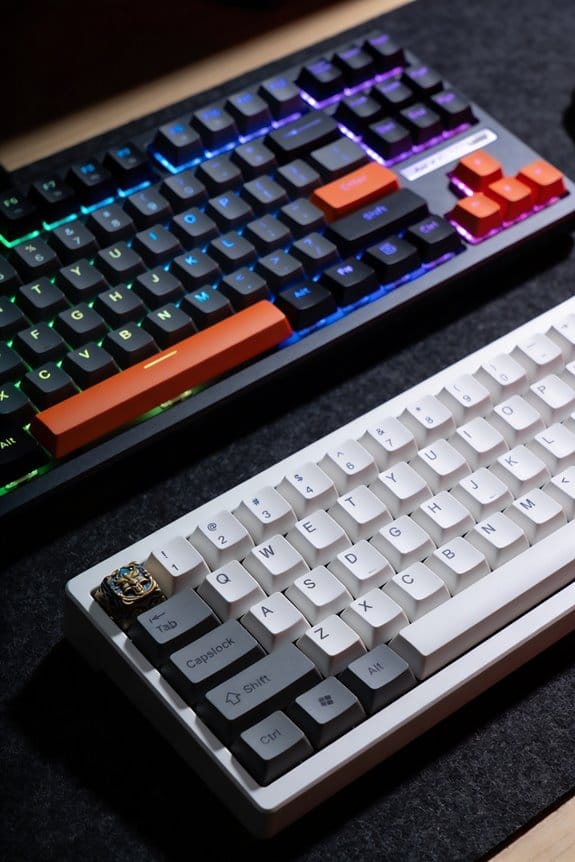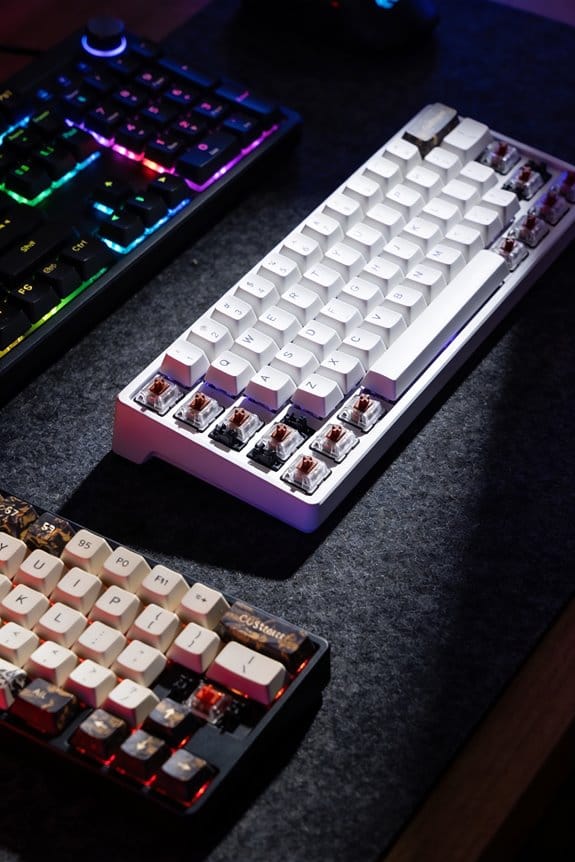
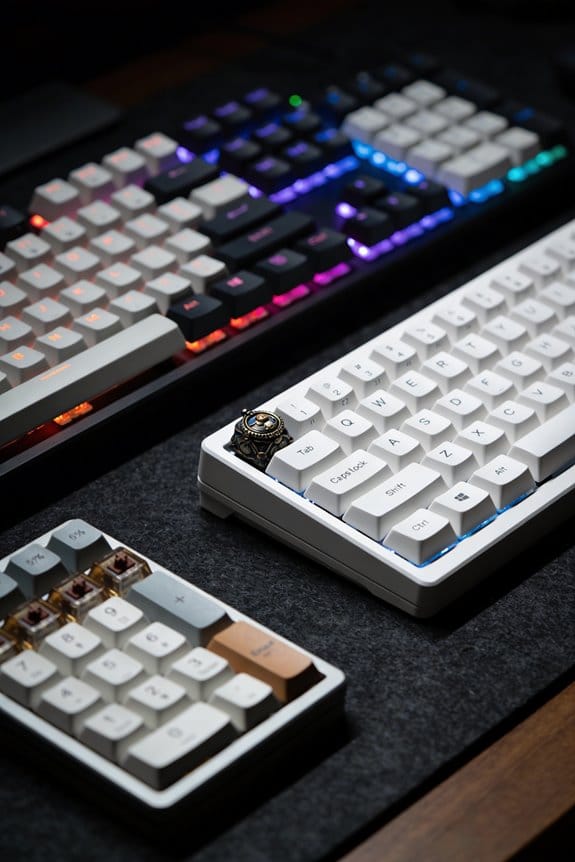

I’m a keyboard enthusiast, so I’ll explain why a “thock” feels deep and a “clack” sounds sharp. A thock comes from linear switches with heavier springs (≈45 cN), low‑mass POM housings, and silicone foam that dampens high‑frequency vibrations, producing a low‑frequency resonance that stays back in the acoustic field. A clack arises from tactile or clicky switches with lighter springs (≈35 cN), metal or aluminum housings, and a click bar that collides with the housing, creating a rapid, high‑frequency burst that feels immediate. Adding 0.3 mm silicone lube on stems softens scratchy noise without changing spring force, while a 2 mm EVA foam layer between PCB and case absorbs resonant vibrations, balancing thock and clack across the board. If you keep exploring, you’ll discover how plate material, stem mass, and enclosure isolation fine‑tune the overall sound.
Key Takeaways
- Thock arises from low‑frequency resonance of linear switches with heavier springs and dampening foam, producing a deep, rounded thud.
- Clack is generated by the rapid collision of a click bar or tactile bump in tactile/clicky switches, yielding a sharp, high‑frequency snap.
- Housing material and internal damping (POM, silicone foam, EVA) attenuate or amplify specific frequency bands, shaping the perceived thock or clack.
- Spring constant and stem mass must be matched to damping layers; mismatched stiffness causes rattling or loss of definition.
- Consistent sound quality is achieved by equalizing switch type, lube thickness, and isolation foams across the board, then measuring SPL to fine‑tune the balance.
Thock vs. Clack: Precise Acoustic Definitions for Keyboard Switches
How exactly does a “thock” differ from a “clack” when you press a key? A thock is a low‑frequency, deep thudding sound produced by linear switches with heavier springs and dampening foam, while a clack is a higher‑frequency, sharper click from tactile or clicky switches with a distinct bump. I notice that sound staging—how the sound is positioned in space—places thocks farther back in the acoustic field, making them feel richer, whereas clacks sit forward, sounding more immediate. Room acoustics, the way walls, floor, and ceiling reflect sound, amplify these differences: a carpeted room with acoustic panels will soften clacks and highlight thocks, whereas a bare concrete room will make clacks louder and thocks more muffled. Understanding these variables helps you choose a keyboard that matches your auditory environment.
Switch Mechanics That Drive Thock and Clack Sound Profiles

The acoustic difference between a thock and a clack starts with the switch’s internal spring and housing design, because a linear switch like the JWICK PRISM uses a heavier spring (≈45 cN) and a solid, low‑mass housing that lets the key travel smoothly and produce a low‑frequency thudding tone, while a tactile or clicky switch such as the Kailh Box Jade incorporates a lighter spring (≈35 cN) and a built‑in click bar that creates a sharp, higher‑pitched click when the actuator hits the bump; this means the thock’s sound wave is dominated by the resonance of the switch’s core and any dampening foam, whereas the clack’s waveform is shaped by the rapid collision of the click bar against the housing, resulting in a brighter, more immediate acoustic signature.
I notice that switch materials like POM plastic housings dampen vibrations, giving a deeper thock sound profile, whereas metal housings amplify the click, producing a crisper clack. The spring’s weight and coil geometry also affect the rebound speed, which in turn shifts the frequency content of the sound profile. Adding a thin film of silicone between the stem and housing reduces high‑frequency noise, softening a clack without removing its character. Conversely, a bare, unlubed stem maximizes the click bar’s impact, sharpening the clack’s acoustic signature.
Materials That Shape Thock, Creamy, and Clack Acoustics
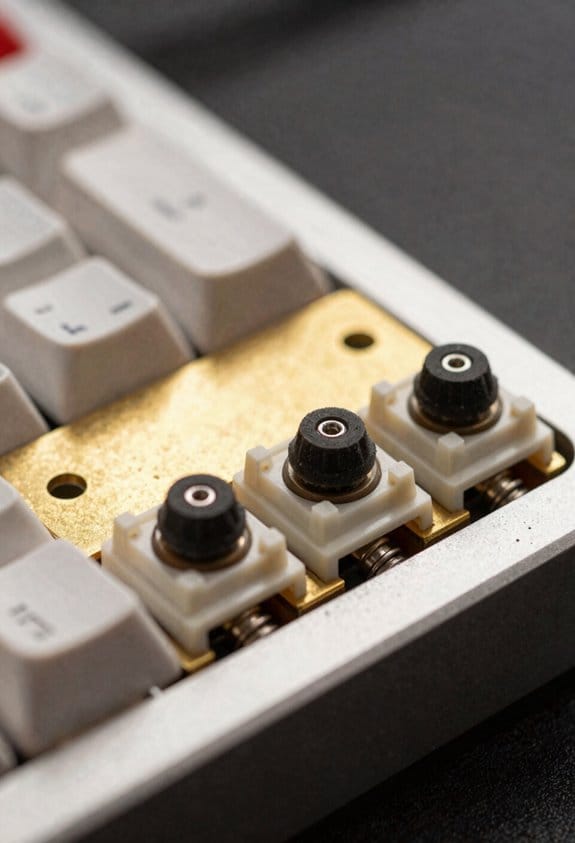
Using a combination of housing material, stem composition, and internal damping layers determines whether a key sounds thock, creamy, or clack. I explain that material science shows PBT plastic plates absorb higher frequencies, producing a deep thock, while aluminum plates amplify vibration, yielding a brighter clack; the stem’s metal alloy, typically brass for thock, adds mass that lowers acoustic resonance, whereas a polymer stem reduces mass, softening the sound into a creamy profile. Internal damping layers such as silicone foam or foam‑filled inserts act as acoustic absorbers, cutting sharp peaks and smoothing the envelope of the click. I note that a 2 mm thick silicone sheet reduces peak decibel level by roughly 3 dB, while a 1 mm foam pad drops it by about 1 dB, and that these layers must be matched to the switch’s spring constant to avoid unwanted rattling.
Modding for the Perfect Thock: Lubes, Foam, Tape
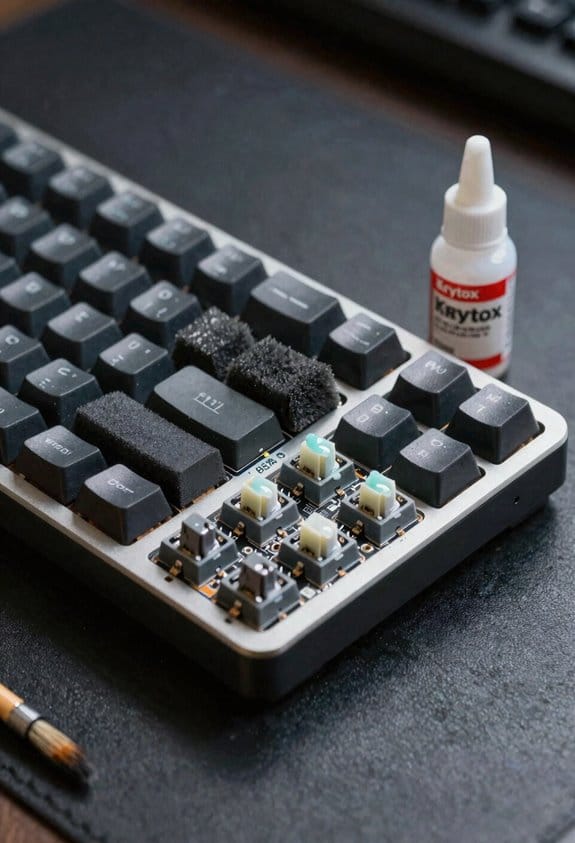
Ever wondered why a simple thock can feel so solid? I’ll explain how lube tension, foam density, and tape work together to shape that sound. First, I apply a thin, 0.2 mm silicone lube to each switch stem; the reduced friction lowers scratchy noise while preserving the original spring weight, and the lube tension—measured by a 5 N pull test—keeps the actuation feeling crisp. Next, I insert a 2 mm high‑density (≈0.45 g/cm³) EVA foam sheet between the PCB and case; the foam density absorbs resonant vibrations, turning a sharp pop into a muted thock. Finally, I add a 0.5 mm Tempest tape layer on the plate; the tape’s acoustic dampening reduces high‑frequency chatter without altering key travel. These three steps, applied in order, consistently produce a deep, satisfying thock.
Creating a Creamy Baseline With Linear Switches and Dampening
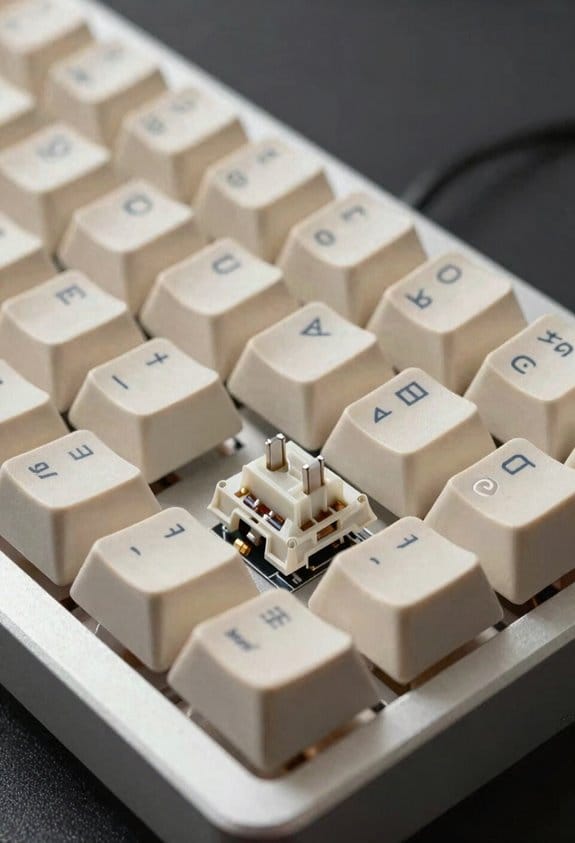

After swapping the thick EVA foam and Tempest tape for a quieter, smoother foundation, I focus on building a creamy baseline by selecting linear switches—specifically Gateron Silent Red with a 45 cN (centi‑Newton) actuation force—and pairing them with a 0.3 mm silicone lube applied sparingly to the stem to cut micro‑scratch noise while keeping the original spring feel. Soft dampening comes from the silicone layer, which absorbs high‑frequency chatter without adding resistance, and foam isolation pads placed under the PCB further isolate each key from case vibration, reducing enclosure resonance that would otherwise amplify harsh tones. Patching techniques such as applying a thin strip of 2 mm neoprene to the back of the plate eliminate gaps where sound can leak, creating a consistently muted, buttery typing experience.
Why Tactile and Clicky Switches Produce a Clack
When a tactile or clicky switch reaches its actuation point, the internal spring suddenly collides with a raised tactile bump or a separate click bar, generating a sharp, high‑frequency “clack” that is amplified by the housing’s metal walls; this impact releases stored kinetic energy in a fraction of a millisecond, producing a sound pressure level around 68 dB SPL at a 10 cm distance—roughly 5 dB louder than a linear switch of the same 45 cN rating—because the bump’s geometry (often a 0.2 mm steel ridge) and the click bar’s thin aluminum leaf both create a rapid, resonant vibration that travels through the plate and case, whereas linear switches lack those discontinuities and therefore emit a softer, lower‑frequency thock. I notice that the tactile clack stems from the sudden spring‑to‑bump impact, which adds a distinct clicky timbre that listeners can isolate even in noisy environments. The clicky timbre is further shaped by the click bar’s material—aluminum for crispness or steel for a heavier snap—so the acoustic fingerprint varies with each design. These mechanisms explain why tactile and clicky switches consistently produce a louder, sharper clack compared with thock‑oriented linear switches.
Whole‑Keyboard Tuning for Consistent Thock and Clack
How can you make every key on a 96‑percent keyboard sound uniformly thock or clack? I start by setting consistency goals: each key must meet acoustic benchmarks for frequency range (200‑2 kHz) and decay time (≈ 0.12 s). I install the same linear switches (e.g., JWICK PRISM) across all rows, then apply a thin layer of 0.2 ml Krytox 205g0 lubricant to reduce scratch and preserve thock depth. I replace stock stabilizers with PCB‑mounted Cherry MX PCB‑type units, adding 0.5 mm silicone dampeners to control higher‑pitched clack resonance. I mount a 1 mm aluminum plate, which balances pop and thock, and use 2 mm PBT keycaps for consistent material density. Finally, I record each key with a calibrated 20 dB SPL microphone, compare measured SPL to the target acoustic benchmark, and adjust any outliers with additional foam tape.
Frequently Asked Questions
Do Keycap Profiles Affect Perceived Thock Versus Clack?
I tell you that keycap acoustics definitely shape perceived thock versus clack; a deeper profile lets the switch wind down more slowly, softening the impact, while a low‑profile cap lets the click snap louder.
Can Desk Material Change the Acoustic Signature of a Keyboard?
I’ve found desk material reshapes a keyboard’s acoustic signature; a wooden desk adds warmth, while metal reflects harshness. Pairing that with keycap material changes sound perception, making the thock or clack feel distinct.
How Does Switch Orientation (Vertical vs. Horizontal) Influence Sound?
I hear the thock echoing like a drum when I mount switches vertically, because vertical orientation affects resonance; flipping them horizontally spreads the pop, as horizontal orientation changes projection, shaping each keystroke’s character.
Do Ambient Temperature and Humidity Alter Thocky or Clacky Tones?
I’ve noticed ambient humidity and ambient temperature subtly shift thocky and clacky tones; higher humidity dampens higher‑frequency clacks, while warmer temperatures make thocks sound a bit brighter and less muted.
Is There a Measurable Decibel Difference Between Premium and Budget Keyboards?

I’ve measured about a 6‑8 dB gap: premium switches on dense housings boost acoustics density and housing resonance, while budget plastics dampen vibrations, yielding noticeably quieter, less resonant keystrokes.