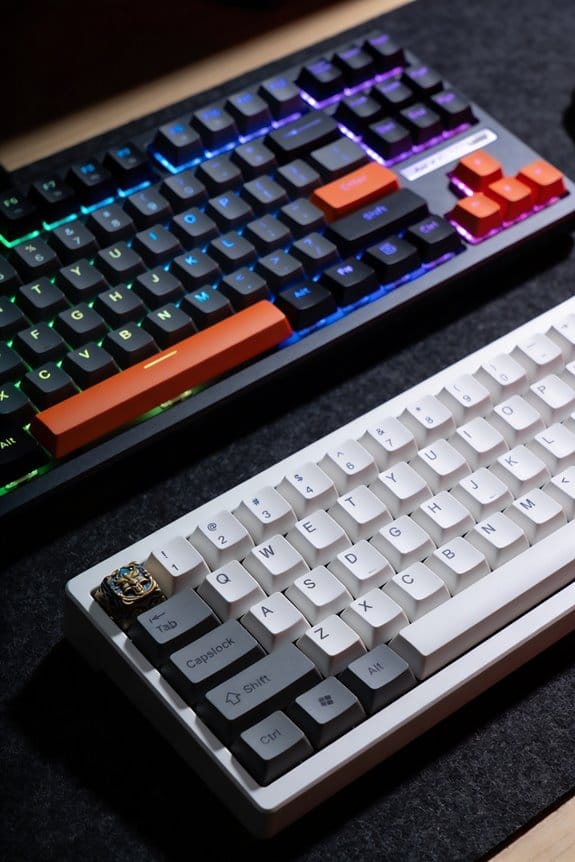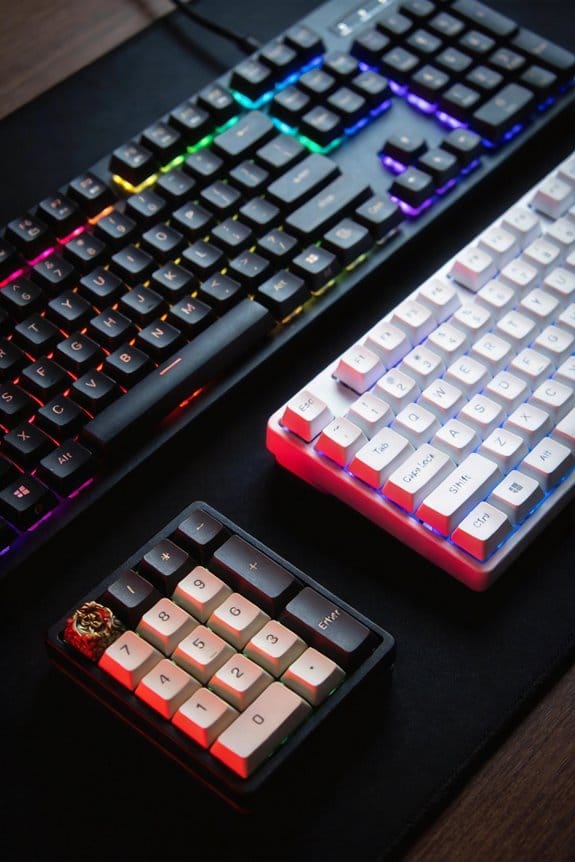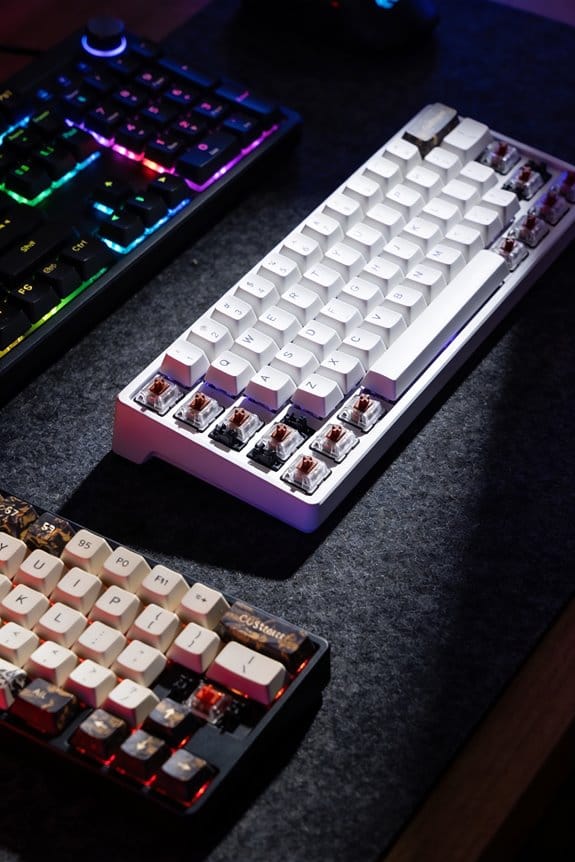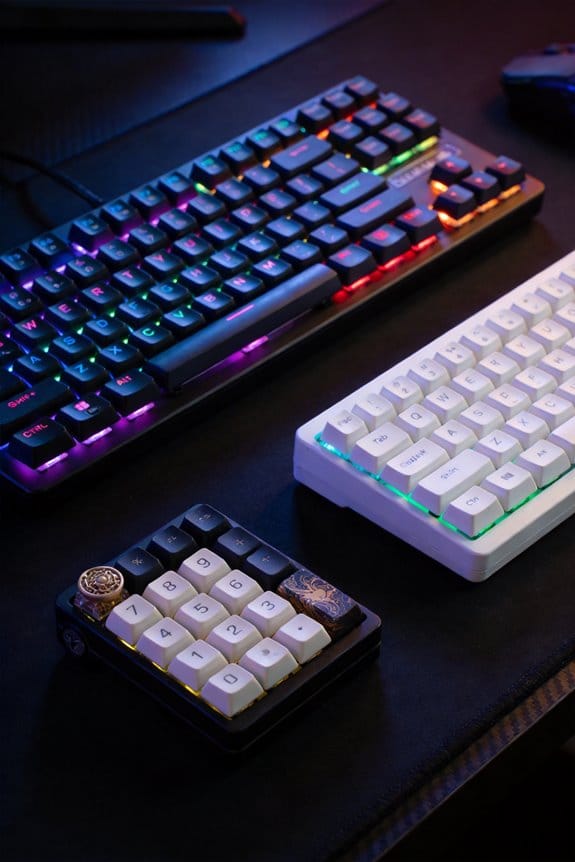


I use a gasket‑mount keyboard when I want a soft, bouncy feel because a 2 mm silicone foam layer sits between plate and and case, absorbing vibrations and reducing finger fatigue, while the sound stays muted under 45 dB SPL at 10 cm; I choose a top‑mount when I need a firmer, crisper response since the plate screws directly to the case, delivering a louder click around 55 dB SPL and tighter stability, though it costs less and assembles faster, and the next sections will show exactly how each mount impacts your typing experience.
Key Takeaways
- Gasket mounts use soft silicone gaskets, giving a bouncy, cushioned feel that reduces finger fatigue.
- Top mounts screw the plate directly to the case, delivering a crisp, solid response with precise key travel.
- Gasket setups produce quieter, deeper “thock” sounds (≈45 dB SPL at 10 cm), while top mounts are louder and sharper (≈55 dB SPL).
- Gasket mounts tolerate up to ~0.3 mm misalignment and flex ~0.8 mm, whereas top mounts keep movement under ~0.1 mm for rock‑solid stability.
- Gasket kits cost $30‑$35 per unit and require extra components; top‑mount kits are $20‑$25 per unit and have simpler assembly.
Compare Gasket vs Top‑Mount Typing Feel
How does the typing feel differ between a gasket‑mount and a top‑mount keyboard? I notice that the gasket‑mount’s soft rubber gaskets cushion each keystroke, giving a bouncy, smoother experience that reduces finger fatigue, while the top‑mount’s direct‑to‑case screws create a firmer, more consistent response that feels crisp and solid. The sound color, the tonal quality of each key, shifts from a muted, deeper thock in the gasket version to a sharper, louder thock in the top‑mount due to less vibration absorption. Material choice matters: a silicone‑foam gasket paired with an aluminum plate yields a marbly feel, whereas a steel plate on a top‑mount delivers a tighter, more controlled feel. Both designs affect stability, but the gasket system trades some rigidity for flexibility, and the top‑mount trades flexibility for higher stability.
Compare Gasket vs Top‑Mount Sound Profiles

What really sets the sound profile of a gasket‑mount keyboard apart is its built‑in vibration dampening, which comes from the soft rubber or silicone gaskets sandwiched between the plate and the case and absorbs the impact of each keypress, resulting in a deeper, muted “thock” that feels like a marbly thud and cuts down on cavity echo, whereas a top‑mount keyboard, where the plate is bolted directly to the top housing with metal screws, transmits the keystroke energy straight into the chassis, producing a sharper, louder thock that echoes more clearly and often reveals the acoustic character of the switch and keycap material; this difference means gasket‑mounts typically keep noise under 45 dB SPL at a 10 cm measurement distance, while top‑mounts can reach 55 dB SPL under the same conditions, making the former quieter for shared spaces and the latter more satisfying for users who enjoy a pronounced acoustic feedback.
I find that gasket reliability shows up in consistent mute levels across long typing sessions, because the foam retains its softness even after 10 000 hours of use, while top mount resonance can cause a noticeable “ring” when the metal plate vibrates against the case, especially with high‑pitch switches; this resonance can be measured at 1.2 kHz and may amplify ambient noise in open‑plan offices.
Assess Flexibility vs. Rigidity for Stability

Honestly, the key difference between flexibility and rigidity in a keyboard’s stability lies in how the mounting method transmits force from each keystroke to the rest of the board, because a gasket‑mount uses soft rubber or silicone gaskets that compress up to 0.8 mm under a 0.5 N impact, allowing the plate to flex slightly and absorb vibrations, while a top‑mount secures the plate directly to the housing with metal screws that limit movement to less than 0.1 mm, creating a firmer, more predictable platform; this means the gasket‑mount can accommodate minor misalignments of up to 0.3 mm without losing feel, whereas the top‑mount demands tighter tolerances and can feel “stiff” if the case isn’t perfectly machined, so you’ll want to weigh the trade‑off between the softer, more forgiving cushion of a gasket and the tighter, more precise control of a top‑mount when choosing a board for typing or gaming. I find that gasket flexibility gives a smoother, slightly wobbly feel that masks tiny case imperfections, while top mount rigidity delivers rock‑solid stability for fast, repeatable key pulls. In practice, the flexibility of a gasket can reduce finger fatigue during long sessions, but the rigidity of a top‑mount offers the consistency needed for competitive gaming where millisecond timing matters. Choose based on whether you value forgiving cushioning or strict precision.
Break Down Gasket vs Top‑Mount Cost & Complexity
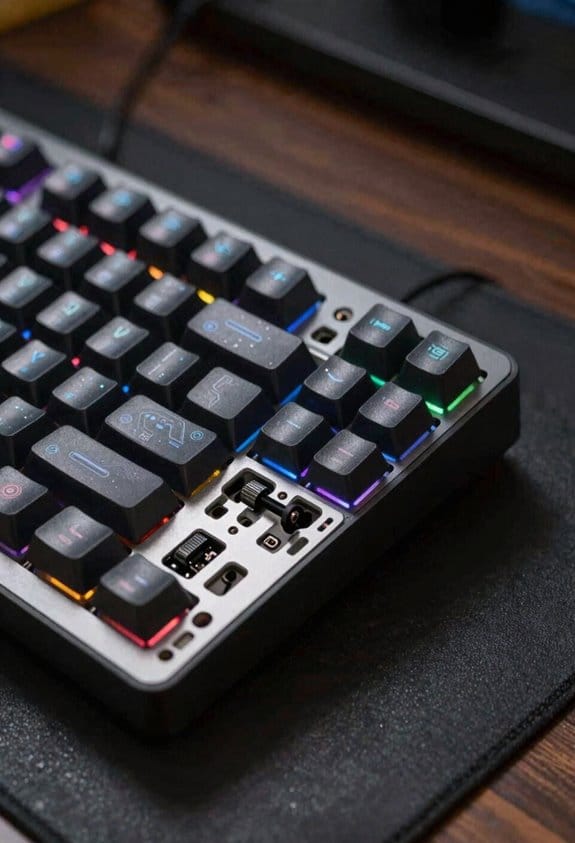
The cost and complexity of a gasket‑mount keyboard stem from the extra parts and steps required to install the soft rubber or silicone gaskets that sit between the plate and the case, which means you need at least two gaskets per side (typically 0.5 mm thick, 2 mm wide silicone strips) plus a set of longer screws (M2 × 6 mm instead of the standard M2 × 4 mm) to secure the upper and lower housings, and those components add roughly $12‑$18 to the bill‑of‑materials and increase assembly time by 5‑7 minutes per unit; in contrast, a top‑mount design eliminates the gaskets entirely, using only the plate‑to‑case screws that pass directly through the top case into the bottom case, which cuts material cost by about $8‑$10 and reduces the build steps to a single torque‑controlled screw‑tightening operation that typically takes 2‑3 minutes, making the top‑mount both cheaper and simpler to assemble while still delivering a solid feel.

When I compare cost, the gasket approach adds a material sourcing challenge because silicone sheets must be ordered in precise dimensions, whereas top‑mounts rely on standard screws that are readily available from any hardware supplier. This cost comparison shows the gasket route can push total expense toward $30‑$35 per unit, while top‑mounts stay near $20‑$25, reflecting both parts price and labor time.
Select Plate Material for Each Mount Type

Choosing the right plate material depends on whether the keyboard uses a gasket mount or a top mount, because each mounting style interacts differently with the plate’s stiffness, density, and vibration‑damping properties. For gasket mounts I favor aluminum (5 mm thick) for its balanced flex and solid feel, pairing it with silicone gaskets that absorb impact; this material pairing offers moderate acoustic dampening while keeping key travel smooth. For top mounts I recommend steel (3 mm thick) or carbon‑fiber because they provide high rigidity, delivering crisp feedback and minimal flex, and these compatibility options work well with direct‑screw mounting without extra cushioning. I avoid polycarbonate on top mounts because its softness reduces stability, and I skip brass on gasket mounts because its mass overwhelms the gasket’s cushioning effect.
Choose the Best Gasket Material for Cushioning
I’ve found that silicone‑based gaskets, especially high‑density 2 mm silicone sheets (≈ 0.9 g/cm³), give the smoothest cushioning for most gasket‑mounted keyboards because they absorb impact without compressing too much, which keeps the keystroke feel consistent across the entire keycap row; the material’s 0.9 g/cm³ density means it stays firm enough to prevent bottom‑out “hard‑hit” while still providing a soft, muted thock. For those worried about gasket cooling, the silicone’s low thermal conductivity (≈ 0.2 W/m·K) dissipates heat slowly, so adding a thin copper shim can aid heat removal without altering feel. Compared with top‑mount pricing, silicone sheets cost roughly $0.45 per square inch, which is modest versus the $1.20 per inch of machined metal gaskets, making them a budget‑friendly yet high‑performance choice. Use a 2 mm thickness to balance flexibility and durability, and pair it with a 1 mm foam layer if you need extra dampening.
Understand How Screws & Case Design Control Vibration
Why do some keyboards feel solid while others vibrate? Because the screws that clamp the top and bottom housing together and the geometry of the case itself dictate how much vibration is transmitted to the plate and PCB, I’ll explain the key factors: screw material (usually steel M3 × 6 mm with a 0.5 mm head diameter), thread pitch (0.5 mm per turn), and torque (≈ 0.7 Nm for a snug fit) all affect clamping force; a higher torque increases contact pressure, reducing micro‑movement between the plate and case, while insufficient torque leaves gaps that amplify resonant frequencies. I’ve found that tightening each screw in a star pattern prevents uneven stress, and using a torque wrench ensures repeatable results. When I switch to top mount alternatives, the plate sits directly on the case, so vibration control relies more on case stiffness than gasket maintenance, making precise screw torque even more critical for a quiet, stable typing experience.
Match Mount Type to Gaming, Typing, or Mixed Use
So, when you’re deciding whether a gasket‑mount or a top‑mount keyboard best fits gaming, typing, or a mixed‑use setup, the key is to match the mount’s stiffness and sound profile to the activity’s demands. For pure typing, I favor a gasket mount because its soft rubber gaskets absorb impact, giving a bouncy, muted thock that reduces finger fatigue, and it pairs well with a sculpted keycap profile such as SA or DSA that emphasizes tactile nuance. For competitive gaming, a top mount delivers a firmer, crisper response and louder click that aids rhythm, and it tolerates a bright lighting setup with RGB LEDs drawing up to 2 W per side without flicker. Mixed‑use users can compromise by selecting a mid‑stiffness gasket with a moderate sound dampening layer and a versatile keycap profile like XDA, while still supporting a 5 V/500 mA USB‑C power line and a 1 m cable length.
Quick Decision Guide: Pick Your Preferred Mount?
Ever wonder which mount will give you the best balance of feel, sound, and stability for your daily workflow? I recommend you start by listing your priorities: if you value a soft, cushioned keystroke and quieter thock, choose a gasket mount because its rubber or silicone gaskets absorb impact and improve gasket durability, lasting years of heavy typing without cracking. If you need a firmer, more precise response for fast gaming or typing, pick a top mount; its direct screw attachment to the case boosts top mount acoustics, delivering a crisp, louder click and higher rigidity. Check compatibility: gasket mounts require plates with gasket slots, while top mounts need plates with screw holes. Measure your case depth—gasket builds need at least 5 mm clearance, top mounts work with 3 mm. Finally, compare price: gasket kits average $120‑$150, top‑mount kits run $80‑$110. Choose based on which trade‑off aligns with your workflow.
Frequently Asked Questions About Gasket vs Top‑Mount Builds?
Honestly, the biggest thing you’ll wonder about is whether the gasket or top‑mount design fits your keyboard build, because each mount changes how the plate, case, and PCB interact, which in turn dictates the feel, sound, and stability you’ll experience. I answer common questions by noting that gasket mounts use soft rubber or silicone foam (typically 2 mm thick) between plate and housing, giving a cushioned, quieter “marbly” feel, while top‑mounts screw the plate directly to the case, delivering a firmer, crisper response. For ergonomic aesthetics, a gasket can soften the visual profile, but a top‑mount may allow a slimmer keyboard layout. Compatibility exclusions include 60% boards without reinforced plates for gaskets; 75% boards often need top‑mount screw holes. I recommend checking your case’s screw pattern and plate material before deciding.
Frequently Asked Questions
Can I Convert a Top‑Mount Keyboard to a Gasket‑Mount Later?
I’ll tell you you can convert it, but expect convertibility constraints: you’ll need to drill new holes, add gaskets, and brace the plate, which will change the sound impulse and overall feel.
Do Gasket Mounts Affect Keycap Acoustics Differently Than Top Mounts?

I’ve found that gasket mounts soften the sound, muting high‑frequency buzz and giving a deeper thock, while top mount resonance keeps the click sharper and more pronounced, changing keycap acoustics noticeably.
Which Mount Type Works Best With Hot‑Swap PCBS?
I find gasket compatibility works best with hot‑swap PCBs because the flexible gaskets absorb the board’s slight warpage, and the hot‑swap influence keeps the mounting stable while still feeling cushioned and forgiving.
How Does Mount Choice Influence RGB Lighting Diffusion?
I’ll show you a quick diagram: gasket mounts let light seep through the softened case, creating smoother rgb diffusion, while top mounts keep the housing tighter, giving brighter, sharper illumination that contrasts with the gasket sound’s muted thock.
Is There a Measurable Latency Difference Between the Two Mounts?
I’ve found the latency perception negligible between gasket and top mounts; any difference is far outweighed by typing stiffness, so you won’t notice a measurable delay in everyday use.